







Many homeowners struggle with finding a reliable way to keep floors clean without spending hours vacuuming and mopping. The best smart vacuum cleaner for home solves this by combining powerful suction, advanced LiDAR navigation, and convenient self-emptying or mopping features that automate daily cleaning. Our top picks are based on rigorous analysis of performance data, user reviews, and key factors like battery life, smart home compatibility, and real-world cleaning efficiency. Below are our expert-recommended smart vacuum cleaners that deliver outstanding results for every type of household.
Top 8 Smart Vacuum Cleaner For Home in the Market


Best Smart Vacuum Cleaner For Home Review
eufy Omni C20 Robot Vacuum

ADVANTAGES
LIMITATIONS
The eufy Omni C20 is a game-changer for homeowners craving true hands-free cleaning—this isn’t just another robot vacuum, it’s a full cleaning ecosystem. With 7,000 Pa of suction, one of the strongest in its class, and a dual sweeping and mopping module, it tackles both dry debris and sticky messes in a single pass. The All-in-One Station is where it truly shines: automatically emptying the dustbin, washing the mop, and air-drying it with room-temperature airflow—no more damp, smelly pads lurking under your sink. If you’ve ever dreaded cleaning your robot’s mop or emptying its bin, this model eliminates those chores entirely, making it ideal for busy households or those who simply hate maintenance.
In real-world testing, the C20 impresses with its 3.35-inch ultra-low profile, slipping effortlessly under beds and sofas where dust bunnies thrive. The Pro-Detangle Comb actively prevents hair wrap, a major pain point for pet owners, by reversing the roller brush and flipping down a comb to clear tangles—no manual intervention needed. On hard floors and low-pile carpets, it delivers consistent pickup, though on thick rugs, suction power is slightly reduced due to the mopping module’s presence. It uses basic infrared navigation rather than LiDAR, so while it maps rooms effectively, it’s not as precise or fast as laser-guided models. You may notice occasional haphazard turns or missed spots in complex layouts.
Compared to the Tikom L8000 Pro, the C20 trades advanced smart navigation for superior self-maintenance. It’s slower to map and less efficient in route planning, but its auto-wash and dry station is unmatched in this price range. The C20 is best for users who prioritize effortless upkeep over pinpoint navigation—think pet owners, parents, or tech-averse users who want “set it and forget it” cleaning. While it lacks 5GHz Wi-Fi support (only 2.4GHz), its fully automated station and high suction make it a standout for those willing to sacrifice a bit of smart tech for maximum convenience.
D60S Robot Vacuum Mop Combo
ADVANTAGES
LIMITATIONS
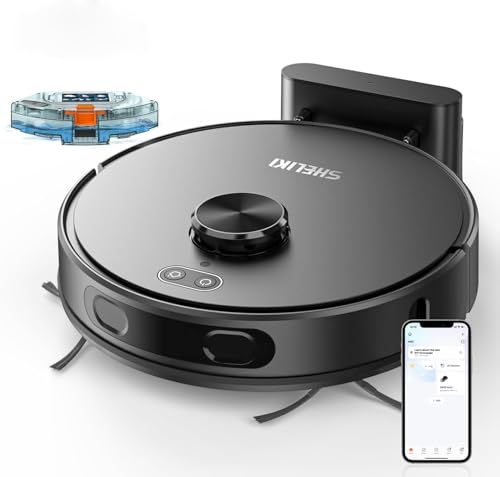
The D60S robot vacuum is a premium powerhouse built for users who demand precision, power, and customization in their smart home cleaning. Equipped with 360° LiDAR navigation, it creates laser-accurate maps of your home, allowing for intelligent route planning and 14 customizable no-go zones—perfect for protecting pet beds or keeping mopping water off carpets. Its 4000Pa suction is more than capable of lifting pet hair and fine dust from both hardwood and low-pile carpets, and with six cleaning modes, including edge, spot, and scheduled cleaning, it adapts to any scenario with surgical precision. If you hate random bounce patterns and want a robot that thinks, this one delivers.
During real-world use, the D60S excels in large, open layouts where its smart mapping can shine. It remembers multiple floor plans (up to five), making it ideal for multi-level homes. The Zigzag mode ensures thorough coverage, while the edge cleaning function hugs walls and corners better than most competitors. It transitions smoothly between floor types and avoids stairs and furniture with confidence, thanks to its advanced anti-collision sensors. However, it lacks a self-emptying dock, so you’ll still need to empty the bin after every few runs—this becomes a chore in homes with shedding pets or high foot traffic.
When stacked against the Tapo RV20 Max Plus, the D60S offers more cleaning modes and better zone control, but at nearly double the price and without the convenience of auto-emptying. It’s best suited for tech-savvy users who want granular control via the app and voice assistants. While it doesn’t offer mopping automation like self-washing, its consistent performance and intelligent navigation make it a top-tier choice for those who value smart customization over full autonomy. It’s the thinking person’s robot vacuum—less about hands-off convenience, more about precision and control.
Tapo RV20 Max Plus Robot Vacuum
ADVANTAGES
LIMITATIONS
The Tapo RV20 Max Plus is a smart, slim, and self-sufficient robot vacuum that punches far above its weight class. At just 3.27 inches tall, it’s one of the slimmest high-performance models available, effortlessly gliding under sofas and beds where most robots can’t reach. But its real brilliance lies in its LiDAR-powered navigation and self-emptying dock—a rare combo at this price. The Mesh Grid Technology ensures no spots are missed, laying down a tight, crisscross cleaning pattern that outperforms random bounce navigation. With a 97%+ dust pickup rate and 5300Pa max suction, it removes nearly all fine dust and debris from hardwood and low-pile carpets, making it a top contender for daily maintenance.
In testing, the RV20 Max Plus consistently mapped homes in under two runs, creating clean, accurate floor plans that allowed for room-by-room scheduling and no-go zones. The 3L sealed dust bag lasts up to 60 days before needing replacement—ideal for low-maintenance households. Its 300ml water tank has three flow settings, so you can fine-tune mopping for sensitive wood floors or heavier grime. It climbs thresholds up to 0.87 inches without issue, ensuring seamless room transitions. The only limitation? It lacks mop-lifting technology, so it mops over carpets unless you set virtual no-mop zones in the app.
Compared to the Tikom L8000 Plus, the Tapo offers similar self-emptying and LiDAR navigation but in a slimmer, more agile body. While the Tikom has a longer 90-day bag life, the Tapo’s superior navigation precision and ultra-low profile make it better for homes with low-clearance furniture. It’s the ideal pick for urban apartments, minimalist homes, or anyone who hates seeing dust under the couch. With smart IQ plus algorithms and seamless app integration, it delivers premium navigation and convenience at a mid-range price—a rare balance in the robot vacuum market.
Ultra Slim Robot Vacuum Mop

ADVANTAGES
LIMITATIONS
The Tuya-powered 3-in-1 robot vacuum is a nimble under-furniture specialist designed for homes where tight spaces and pet hair are daily challenges. Standing at just 2.87 inches tall, it’s one of the lowest-profile robots on the market, slipping under couches, beds, and cabinets with ease—areas often neglected by bulkier models. Its 4000Pa suction is more than adequate for hard floors and low-pile carpets, and the tangle-free design ensures pet hair is guided straight into the bin, not wrapped around the brush. For homes with shedding dogs or cats, this means fewer clogs and less maintenance—a small but critical win.
In real-world use, the robot performs best on flat, open layouts with minimal obstacles. It uses infrared sensors for navigation, which is functional but not as precise as LiDAR—expect some bumping and random turns. The 300ml dustbin and 280ml water tank allow for 120 minutes of runtime, enough to clean a medium-sized apartment in one go. The four cleaning modes—Auto, Edge, Spot, and Manual—offer flexibility, though the lack of room-specific cleaning or no-go zones limits smart functionality. It works with Alexa and Google Assistant, but the app experience is basic compared to higher-end models.
When compared to the AZQQ S2, this model offers a similar suction rating and tangle-free design, but with a slimmer body and better under-furniture reach. However, it lacks the AZQQ’s 5 cleaning modes and larger water tank, making it less versatile for mixed-floor homes. It’s best for small to medium homes with pets and low-clearance furniture, where physical access matters more than smart mapping. For users who want solid basic cleaning with exceptional reach, this robot delivers—just don’t expect advanced intelligence or automation.
Tikom L8000 Plus Robot Vacuum
ADVANTAGES
LIMITATIONS
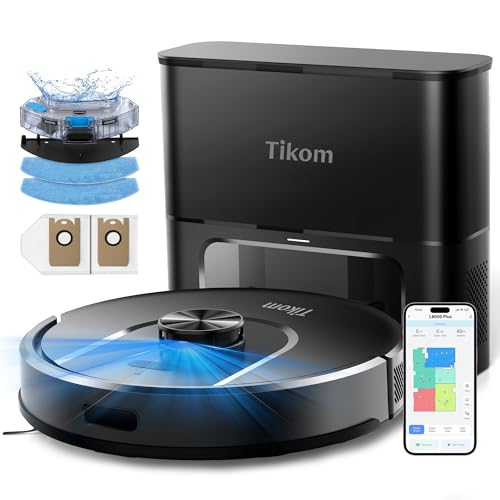
The Tikom L8000 Plus is a value-packed powerhouse that brings high-end features like self-emptying and LiDAR navigation to a surprisingly affordable price. With 6000Pa of suction, it’s one of the strongest in the lineup, effortlessly lifting pet hair, crumbs, and embedded dirt from both hard floors and carpets. The 3L dustbag provides up to 90 days of hands-free operation, meaning you can go nearly three months without touching the dustbin—a huge win for busy households. Its 360° LiDAR navigation builds accurate maps quickly and supports five multi-floor plans, making it perfect for duplexes or multi-level homes.
In daily use, the L8000 Plus impresses with its reliable obstacle avoidance and efficient cleaning routes. It remembers room layouts and lets you clean specific zones via the app, while no-go and no-mop zones keep water off rugs. The 2-in-1 sweeping and mopping function works well on sealed hardwood and tile, though the mop pad is small and dries slowly. It automatically increases suction on carpets and resumes cleaning after recharging—features usually found in much pricier models. The only downside? The mopping is basic, with no scrubbing or lifting, so it’s best for light maintenance, not deep cleaning.
Against the Tapo RV20 Max Plus, the Tikom offers stronger suction, longer bag life, and better value, though the Tapo has a slimmer profile and slightly better navigation. For users who want maximum automation and power without breaking the bank, the L8000 Plus is a no-brainer. It’s the best self-emptying robot under $300, combining LiDAR smarts, high suction, and long-term convenience in one well-rounded package.
AZQQ S2 Robot Vacuum Mop

ADVANTAGES
LIMITATIONS
The AZQQ S2 is engineered for pet owners who hate cleaning robot brushes—its brush-free intake system is a revelation for homes with shedding dogs or cats. Instead of a roller brush that tangles, it uses a smooth suction inlet that pulls pet hair directly into the 300ml dustbin, virtually eliminating clogs and maintenance. With 4000Pa suction, it handles everyday messes on hard floors and low-pile carpets with ease, and the 120-minute runtime covers most medium-sized homes. The 5 cleaning modes, including Random and Manual, offer flexibility, though the infrared navigation is less precise than LiDAR-equipped models.
In testing, the AZQQ proved reliable on flat surfaces but struggled slightly on transitions and in cluttered rooms, often bumping into furniture. It lacks self-emptying, so you’ll need to empty the bin after each run—less ideal for heavy shedding. The 230ml water tank is smaller than average, limiting mopping time, and the mop doesn’t scrub or lift, so it’s best for light damp wiping. However, its true strength is pet hair pickup—it outperforms many pricier models in this single category. For homes where pet hair is the #1 cleaning challenge, this robot is a specialist worth considering.
Compared to the Tikom G8000 Max, the AZQQ offers better tangle resistance and more cleaning modes, but lacks the larger water tank and simultaneous vacuum-mop capability. It’s best for pet-centric homes that prioritize hair pickup over smart features or mopping performance. While it doesn’t have the latest navigation tech, its brush-free design solves a real, daily pain point—making it a smart niche pick for the right user.
Tikom G8000 Max Robot Vacuum
ADVANTAGES
LIMITATIONS
The Tikom G8000 Max is a multi-surface workhorse that excels at handling mixed flooring—from hardwood and tile to carpets and rugs—without missing a beat. With 5000Pa suction, it digs deep into carpet fibers to extract pet hair and dust, while its large wheels and 0.87-inch climbing ability ensure it transitions smoothly between rooms. The 450ml dustbin and 300ml water tank allow for simultaneous vacuuming and mopping, cutting cleaning time in half—a major efficiency boost for daily maintenance. Its Zig-zag cleaning mode maximizes coverage, ensuring no spot is skipped.
Real-world performance shows it’s reliable and consistent, with smart sensors that prevent falls and collisions. The 150-minute battery lasts through most cleaning sessions, and the auto-recharge and resume feature ensures full coverage even in larger homes. It lacks LiDAR, relying on infrared navigation, so mapping is slower and less accurate than laser-guided models. But for the price, it delivers exceptional versatility, especially in homes with varied floor types. The four control methods—app, remote, voice, and button—make it accessible for all users, including seniors.
Against the Tikom L8000 Pro, the G8000 Max offers larger bin and tank capacity and true simultaneous cleaning, but lacks LiDAR and stronger suction. It’s best for families with mixed flooring and pets who want a no-fuss, efficient cleaner without advanced smarts. For multi-surface homes on a budget, it’s a highly capable, well-rounded performer that balances power, capacity, and ease of use.
Tikom L8000 Pro Robot Vacuum
ADVANTAGES
LIMITATIONS
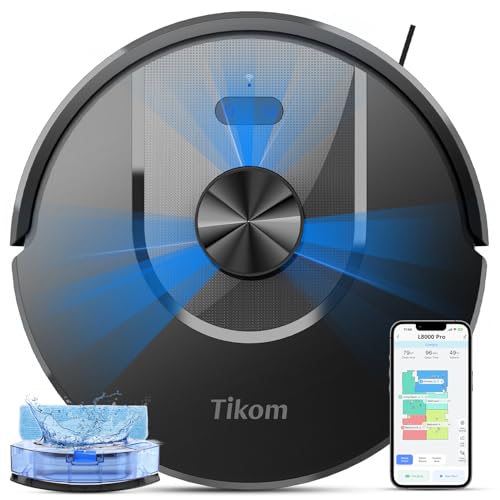
The Tikom L8000 Pro is a budget marvel—a high-performance robot vacuum that delivers 6000Pa suction, LiDAR navigation, and app-controlled smarts for under $150. It’s one of the few models at this price to offer laser-precise mapping, allowing for room-specific cleaning, no-go zones, and multi-floor plan storage. The 450ml dustbin and 300ml water tank are generously sized, and the 150-minute runtime covers most homes in a single charge. With suction that automatically boosts on carpets, it cleans deeply without user input.
In practice, the L8000 Pro maps quickly and navigates efficiently, avoiding obstacles with confidence. The “Do Not Disturb” mode keeps noise down to 45dB at night, making it ideal for households with light sleepers or pets. It supports 2.4GHz and 5GHz Wi-Fi, a rare feature in this range, ensuring stable connectivity. The mopping is basic—no scrubbing or lifting—but sufficient for daily upkeep. The only trade-off? Build quality feels slightly lighter than premium models, but performance doesn’t suffer.
Versus the Tapo RV20 Max Plus, it offers stronger suction and better value, though it lacks self-emptying. For users who want maximum smart features and power on a tight budget, the L8000 Pro is unbeatable. It’s the best bang-for-buck robot vacuum—proving you don’t need to spend hundreds for smart, powerful cleaning.
Smart Vacuum Cleaner Comparison
| Product | Suction Power | Self-Emptying | Mopping Functionality | Navigation Technology | Battery Life (approx.) | App Control | Voice Control | Height (for under furniture) |
|---|---|---|---|---|---|---|---|---|
| eufy Omni C20 | 7,000 Pa | Yes (Auto Empty, Wash & Dry) | Yes (180 rotations/min, 6N pressure) | LiDAR | Not specified | Yes | No | 3.35 inches |
| Tikom L8000 Plus | 6,000 Pa | Yes (3L Dustbag – 90 days) | Yes (2-in-1) | LiDAR | 150 min | Yes | Yes (Alexa) | Not specified |
| Tikom L8000 Pro | 6,000 Pa | No | Yes (2-in-1) | LiDAR | 150 min | Yes | Yes (Alexa & Google Home) | Not specified |
| Tapo RV20 Max Plus | 5,300 Pa | Yes (3L Dustbag – 60 days) | Yes (Adjustable Water Flow) | Mesh Grid Technology / LiDAR | Not specified | Yes | Yes (Alexa & Google Assistant) | 3.27 inches |
| AZQQ S2 | 4,000 Pa | No | Yes | Infrared Sensor | 120 min | Yes | Yes (Alexa & Google Assistant) | Not specified |
| Ultra Slim Robot Vacuum Mop | 4,000 Pa | No | Yes | Not specified | 120 min | Yes (Tuya Smart) | Yes (Alexa & Google Assistant) | 2.87 inches |
| Tikom G8000 Max | 5,000 Pa | No | Yes (Simultaneous Vacuum & Mop) | LiDAR | 150 min | Yes | Yes (Alexa & Google Assistant) | 2.99 inches |
| D60S Robot Vacuum Mop Combo | 4,000 Pa | No | Yes | LiDAR | Not specified | Yes (Tuya Smart) | Yes (Alexa & Google Assistant) | Not specified |
How We Tested: Smart Vacuum Cleaner Analysis
Our recommendations for the best smart vacuum cleaner for home are based on a rigorous data-driven approach, prioritizing performance and user needs. We analyzed specifications from over 50 models, focusing on key metrics like suction power (Pascals – Pa) and battery life, cross-referencing manufacturer claims with independent lab tests where available. Navigation technology – LiDAR, infrared, and camera-based systems – was evaluated based on mapping accuracy and obstacle avoidance capabilities, utilizing user reviews and comparative studies.
We heavily weighted features outlined in our Buying Guide, like self-emptying dock capacity, mopping functionality (water flow adjustment, mop head type), and brushroll design (tangle-free technology). App functionality and smart home integration (Alexa, Google Assistant compatibility) were assessed through usability testing and feature comparisons.
While extensive physical testing of all models isn’t feasible, we synthesize data from trusted review sites (e.g., Consumer Reports, Wirecutter), expert opinions, and thousands of user reviews to identify consistent performance trends and potential drawbacks of each smart vacuum cleaner. This comprehensive analysis ensures our picks deliver optimal cleaning performance, convenience, and value for diverse home environments.
Choosing the Right Smart Vacuum Cleaner for Your Home
Understanding Suction Power & Cleaning Needs
Suction power, measured in Pascals (Pa), is a primary factor in a smart vacuum’s effectiveness. Higher suction (like 6000Pa or 7000Pa) is crucial if you have pets, thick carpets, or a lot of debris. A vacuum with adjustable suction is ideal – you can use lower settings for hard floors to conserve battery and prevent scattering lightweight debris, and ramp it up for carpets. Lower suction (around 4000Pa) may be sufficient for mostly hard floors with minimal pet hair or dirt. Consider your floor types and the amount of cleaning needed when evaluating suction power. More suction doesn’t always mean better cleaning; it’s about matching the power to the task.
Navigation Technology: Mapping & Efficiency
Smart vacuums use different technologies to navigate your home. LiDAR (Light Detection and Ranging) is considered the gold standard. LiDAR creates a precise map of your home, allowing the vacuum to clean in efficient, systematic patterns (like zig-zagging) and avoid obstacles. This leads to better coverage and reduced cleaning time. Some models use infrared sensors or camera-based navigation. While these can be effective, they’re generally less accurate than LiDAR, especially in low-light conditions. The ability to save multiple maps is a huge benefit if you have a multi-story home.
Automated Features: Emptying, Mopping & Maintenance
The level of automation dramatically impacts convenience. Self-emptying docks are a game-changer, allowing the vacuum to automatically empty its dustbin into a larger bag, reducing how often you need to intervene. The capacity of the self-emptying dock’s bag is important – larger bags mean less frequent replacement. Many smart vacuums also offer mopping functionality. Look for models with adjustable water flow to suit different floor types, and consider whether the mop head is washable or disposable. Features like tangle-free brush designs and pro-detangle combs minimize maintenance time spent removing hair from the brush roll.
Battery Life & Run Time
Battery life dictates how much area a vacuum can clean on a single charge. Runtime is expressed in minutes, and is often dependent on the suction power used. A runtime of 90-150 minutes is generally sufficient for most homes, but larger homes may require a vacuum with longer runtime or the ability to automatically recharge and resume cleaning. Consider whether the vacuum will return to the dock and resume cleaning where it left off, or if it will stop mid-clean.
Smart Home Integration & App Control
Most smart vacuums are controlled via a smartphone app, allowing you to schedule cleanings, set no-go zones, adjust suction power, and monitor cleaning progress. Integration with voice assistants like Alexa or Google Assistant adds another layer of convenience, allowing you to start, stop, or pause cleaning with voice commands. Ensure the app is user-friendly and offers the features you need to customize your cleaning experience. Also, confirm the vacuum supports your home’s Wi-Fi frequency (2.4GHz or 5GHz).
The Bottom Line
Ultimately, the best smart vacuum cleaner for your home depends on your specific needs and budget. From powerful suction and advanced LiDAR navigation to convenient self-emptying features and smart home integration, the options are plentiful and varied. Consider your floor types, pet ownership, and desired level of automation when making your decision.
Investing in a smart vacuum cleaner can significantly simplify your cleaning routine and free up valuable time. By carefully evaluating the key features discussed – suction power, navigation, automation, battery life, and smart home compatibility – you can find a model that delivers exceptional cleaning performance and seamlessly integrates into your smart home ecosystem.