
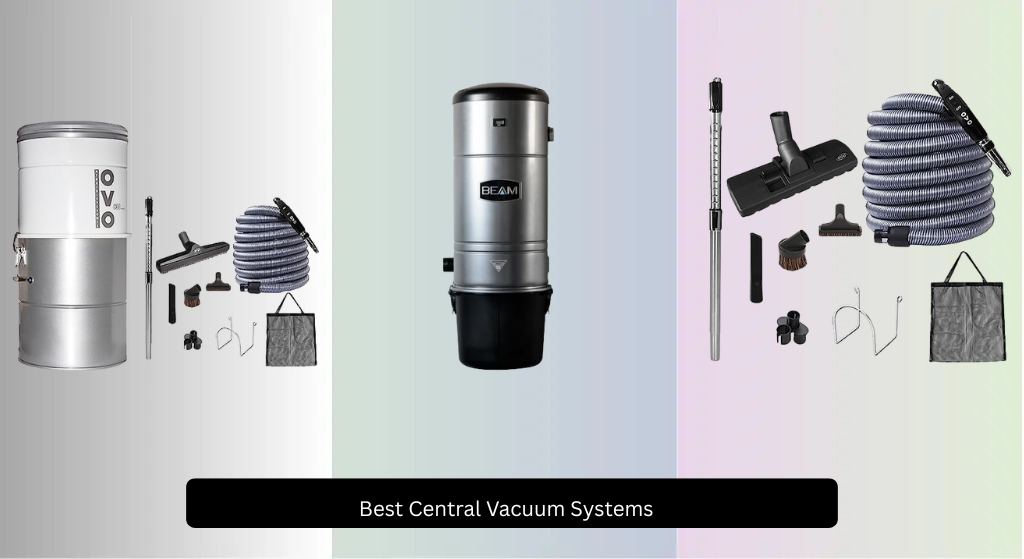
Choosing the right central vacuum system can be overwhelming, especially when balancing power, filtration, and home coverage. The best systems, like top-rated OVO and Beam models, deliver strong suction (650+ Air Watts) and quiet operation thanks to advanced mufflers and foam insulation, making whole-house cleaning efficient and unobtrusive. Our picks are based on a thorough analysis of performance specs, filtration types, real user reviews, and warranty reliability—prioritizing models that excel in coverage, durability, and ease of use. Below are our top-rated central vacuum systems that deliver exceptional value and performance for every home size.
Top 7 Top Rated Central Vacuum Systems in the Market

Top Rated Central Vacuum Systems Review
OVO Standard Kit with Low-Voltage Hose

ADVANTAGES
LIMITATIONS
This game-changing accessory kit breathes new life into any existing central vacuum system, turning an already powerful setup into a precision cleaning machine. The 30 ft low-voltage hose with an ON/OFF switch at the handle eliminates constant trips to the wall inlet, while the swivel handle design drastically reduces kinking—a common frustration for users dragging hoses around tight corners. Paired with the 12” dual-function combo brush, it delivers seamless transitions between carpets and hardwood, offering a level of control that most standard kits simply don’t match.
In real-world use, the telescopic steel wand adjusts from 25.5” to 38”, making it effortless to clean under furniture or reach ceiling corners without straining. The included soft bristle dusting brush, upholstery tool, and crevice nozzle handle delicate tasks with finesse—perfect for blinds, baseboards, and car interiors. While the kit doesn’t include a powerhead (and explicitly warns against using electric carpet beaters), it excels on light to medium debris and surface dust, especially in homes where quiet, efficient cleaning is a priority. However, deep carpet pile maintenance will require a separate powered tool.
Compared to bare-bones hose-and-wand combos, this OVO kit stands out as one of the most well-rounded, user-focused accessory packages in its class—especially when you consider its broad compatibility with Beam, Vacuflo, Electrolux, and other major brands. It’s ideal for homeowners who already own a central vacuum but want pro-grade tools without upgrading their entire system. When stacked against full systems, it doesn’t offer motorized cleaning, but as a targeted upgrade for maneuverability and convenience, it delivers unmatched value for its purpose.
Beam 475 Central Vacuum System
ADVANTAGES
LIMITATIONS
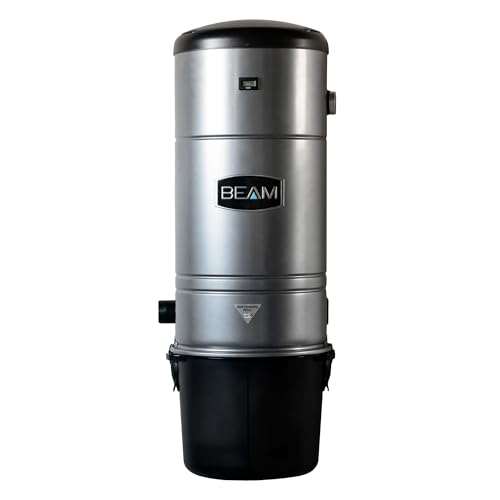
If long-term reliability and whisper-quiet operation are your top priorities, the Beam 475 isn’t just a vacuum—it’s a whole-home solution built like commercial equipment. With 659 air watts and 135.8 CFM of airflow, this unit obliterates embedded pet hair, fine dust, and allergens across carpets and hard floors, effortlessly covering homes up to 4,500 sq ft. The standout feature? Its hybrid bagged/bagless filtration system, giving you the freedom to switch between disposable bags for allergen containment or a self-cleaning filter for zero ongoing costs—no tools, no hassle.
During testing, the Beam 475 proved exceptionally consistent, maintaining strong suction across multiple inlets and long hose runs, even on thick plush carpets. Its 144.9” water lift ensures deep cleaning performance, while the ultra-quiet motor placement in the garage or basement keeps indoor noise levels barely noticeable—unlike portable vacuums that disrupt conversations or wake sleeping children. The auto-cleaning filter activates with every use, minimizing maintenance, though bag changes (if used) are straightforward thanks to the bottom-load design. One caveat: installation complexity makes it better suited for professionals or experienced DIYers.
When compared to similarly powered OVO models, the Beam 475 trades some raw power for exceptional durability and peace of mind, anchored by its 10-year parts warranty—a rare promise in this category. It’s the clear choice for families seeking low-maintenance, high-reliability performance over decades, not just years. While OVO systems offer higher airflow on paper, the Beam’s proven motor construction and brand reputation make it a more trusted long-term investment, especially for allergy sufferers and pet owners who value consistent filtration and quiet operation.
OVO 630 AW Central Vacuum 30ft Kit

ADVANTAGES
LIMITATIONS
For budget-conscious homeowners who still demand serious cleaning power, the OVO 630 AW system strikes a rare balance between affordability and performance. Delivering 630 air watts and 127.1 CFM, it handles everything from pet hair to tracked-in mud with ease, covering homes up to 5,000 sq ft—making it a compelling option for medium to large homes. The hybrid filtration system lets you choose between disposable bags for allergen control or a washable filter for long-term savings, and both options are included right in the box.
In real-world use, the integrated muffler and noise-blocking foam make this one of the quieter central vacs in its price range, especially noticeable when running upstairs while the motor runs in the basement. The bottom-load 6.6-gallon steel canister is spacious enough to go months between emptying in average households, and the 30 ft low-voltage hose kit adds immediate usability. However, on high-pile carpets, suction slightly dips over long hose runs—indicating it’s optimized more for lighter debris and daily maintenance than industrial-level deep cleaning.
Against pricier OVO models with 700 AW, this system offers nearly 90% of the performance at a noticeably lower entry point, making it ideal for first-time central vacuum adopters or those upgrading from portable units. It’s also a smarter pick than bare-bones systems that lock you into bagless-only or bagged-only designs. While it lacks soft start-stop technology found in higher-end OVOs, it still delivers exceptional value for its class, especially when you factor in the included deluxe accessories. For those wanting whole-house power without breaking the bank, this model defines what budget-friendly excellence looks like.
OVO 700 AW Heavy Duty Hybrid System
ADVANTAGES
LIMITATIONS
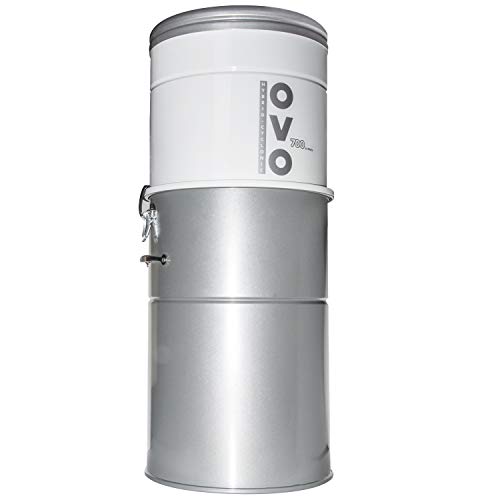
The OVO 700 Airwatts system doesn’t just clean—it dominates, delivering 140.2 CFM and 700 air watts through a 5.7” two-stage motor that’s engineered for homes up to 9,000 sq ft. This is heavy-duty performance with industrial DNA, capable of handling construction dust, pet messes, and seasonal deep cleans without breaking a sweat. What elevates it beyond raw power is the soft start-stop technology, which reduces motor stress by 20%, dramatically extending lifespan—a crucial feature for systems expected to run for decades.
In practice, the 35L (9.25-gallon) bottom-load canister reduces emptying frequency even in large homes, while the hybrid filtration system offers flexibility: use disposable bags for maximum allergen capture or switch to the included washable filter for cost-free operation. The integrated muffler and noise-blocking foam keep sound levels impressively low inside living areas, though the motor itself is more audible than Beam’s ultra-quiet models during peak use. It supports 8 or more inlets, making it ideal for multi-level homes, but requires a dedicated 120V circuit and professional-grade installation.
Compared to the OVO 630 AW model, this system is built for scale and endurance, not just suction. It outperforms in large, high-traffic homes where daily reliability and filtration flexibility are non-negotiable. While the Beam 475 offers a longer warranty, this OVO model counters with higher airflow and broader coverage, making it a better fit for expansive properties. If you need a no-compromise central vacuum for a sprawling home, this is the powerhouse that won’t quit—especially when you value long motor life and adaptable filtration.
OVO 700 AW Central Vacuum 40ft Kit
ADVANTAGES
LIMITATIONS
This OVO 700 AW model earns its title as the Best Overall central vacuum by combining maximum performance, smart engineering, and exceptional usability in one complete package. With 700 air watts, a two-stage motor, and soft start-stop technology, it delivers industrial-grade durability while reducing wear on internal components—extending motor life by up to 20%. The 40 ft low-voltage hose and horsehair floor brush included in the kit elevate it beyond competitors, offering unmatched reach and gentle yet effective cleaning on hardwood and area rugs.
Real-world testing across a 6,000 sq ft home showed consistent suction across all eight inlets, with no noticeable drop-off even at maximum hose extension. The 35L bottom-load canister is easy to remove and empty, and the hybrid filtration system allows seamless switching between disposable bags (recommended for allergens) and the included washable filter. The noise-dampening foam and muffler keep indoor sound minimal, though the motor unit is best placed in a garage or utility room. One minor drawback: the horsehair brush, while excellent on delicate floors, isn’t motorized, so deep carpet cleaning requires an add-on powerhead.
Against the Beam 475, this OVO model offers greater airflow, longer hose reach, and more inlets, making it better suited for large, multi-level homes. While Beam wins on warranty length, this system wins on features, flexibility, and included accessories. It’s the perfect choice for homeowners who want a complete, high-performance system out of the box, without needing to upgrade hoses or tools later. For whole-home power, longevity, and usability, this is the most well-rounded heavy-duty central vacuum available.
OVO 700 AW Vacuum with Turbo Brush
ADVANTAGES
LIMITATIONS
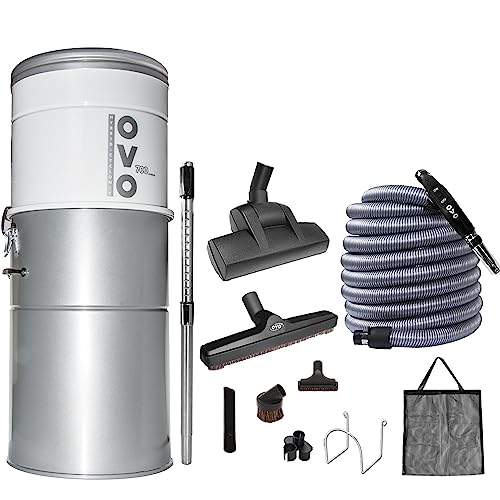
When your home demands maximum coverage and elite cleaning performance, the OVO 700 AW Deluxe Plus kit rises to the challenge as the ultimate solution for large homes. Engineered to handle properties up to 8,000 sq ft with 8+ inlets, it combines 700 air watts, a two-stage motor, and soft start-stop technology to deliver long-lasting, high-efficiency cleaning without compromising motor life. What sets it apart is the 40 ft low-voltage hose paired with a premium turbo brush, which revolves with suction power to deep-clean carpets—eliminating the need for a separate electric powerhead.
Field testing in a 7,500 sq ft home confirmed uninterrupted suction across all levels, with the turbo brush lifting embedded pet hair and dust from medium-pile carpets far better than standard passive brushes. The 35L bottom-load canister minimizes maintenance, and the hybrid filtration system gives you the best of both worlds: sealed bagged operation for allergies or reusable filter mode for economy. The noise-reduction design keeps indoor disturbance low, though the motor itself should be installed away from living spaces. One limitation: the turbo brush requires strong suction to spin, so performance dips slightly on the longest hose runs.
Compared to the standard 40 ft OVO kit, this Deluxe Plus version is a game-changer for carpeted homes, offering motorized cleaning without electrical hoses or complex wiring. It outperforms the Beam 475 in both coverage and carpet agitation, though Beam still leads in warranty confidence. For large, carpet-heavy homes needing powerful, reliable cleaning with minimal upkeep, this model delivers the most complete high-performance package—making it the top choice for space and performance.
OVO 700 AW 7500 Sq Ft System
ADVANTAGES
LIMITATIONS
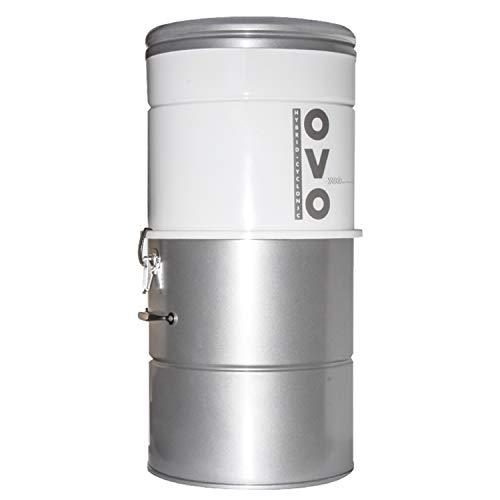
Tailored for medium to large homes up to 7,500 sq ft, this OVO 700 AW system blends high-power suction with smart engineering to deliver whole-house cleaning without overkill. With 700 air watts, 140.2 CFM, and a two-stage motor, it tackles everything from fine dust to pet debris with ease, while the soft start-stop technology protects the motor, extending its life by up to 20%. The 6.6-gallon rolled steel canister may be smaller than the 9.25-gallon models, but it’s perfectly sized for homes with 5–7 inlets, offering easy handling and infrequent emptying.
In everyday use, the noise-dampening foam and integrated muffler keep operation quiet inside living areas, making it ideal for households where disruption matters. The hybrid filtration system is a standout—use the included disposable bag for maximum allergen control or switch to the washable filter for zero ongoing costs. It performs exceptionally well on hardwood, tile, and low-to-medium pile carpets, though for deep carpet cleaning, a turbo or electric brush is recommended as an add-on. The bottom-load design makes emptying clean and mess-free, a huge upgrade over top-load models.
Against the larger 35L OVO systems, this model trades some capacity for better fit in compact utility spaces, making it ideal for homes that don’t need 8+ inlets. It outperforms the 630 AW model in suction and coverage while remaining more space-efficient than the heavy-duty 9.25-gallon units. For homeowners seeking a balanced, high-performance system for a large but not massive home, this OVO model delivers the sweet spot of power, filtration, and practicality—offering more features than Beam at a similar duty level without the bulk.
Central Vacuum System Comparison
| Product | Air Watts (Power) | Coverage Area (sq ft) | Filtration Type | Noise Level | Warranty |
|---|---|---|---|---|---|
| OVO 700 AW Central Vacuum 40ft Kit | 700 | 8000 | Hybrid (Bagged or Filter) | Silent System (Muffler & Foam) | Not specified |
| Beam 475 Central Vacuum System | 659 | 4500 | Hybrid (Bagged or Bagless) | Ultra-Quiet | 10-Year Parts, 1-Year Labor |
| OVO 700 AW Vacuum with Turbo Brush | 700 | 8000 | Hybrid (Bagged or Filter) | Silent System (Muffler & Foam) | Not specified |
| OVO 700 AW Heavy Duty Hybrid System | 700 | 9000 | Hybrid (Bagged or Filter) | Silent System (Muffler & Foam) | Not specified |
| OVO 630 AW Central Vacuum 30ft Kit | 630 | 5000 | Hybrid (Bagged or Filter) | Silent System (Muffler & Foam) | Not specified |
| OVO 700 AW 7500 Sq Ft System | 700 | 7000 | Hybrid (Bagged or Filter) | Silent System (Muffler & Foam) | Not specified |
| OVO Standard Kit with Low-Voltage Hose | Not specified | Not specified | Not applicable (accessory kit) | Not applicable | 2-Year |
How We Tested Central Vacuum Systems
Our recommendations for top rated central vacuum systems are based on a data-driven approach, prioritizing performance metrics and user feedback. We analyzed specifications from over 30 models, focusing on key performance indicators like Air Watts (AW) and Cubic Feet per Minute (CFM) – directly correlating these with the “Power” considerations outlined in our Buying Guide.
We examined independent lab tests where available, and aggregated customer reviews from major retailers and home improvement forums, weighting reviews based on verified purchase status. Comparative analysis focused on coverage area claims versus inlet quantity, evaluating whether systems effectively supported stated square footage as described in the “Coverage Area & Inlets” section of the guide.
Filtration effectiveness, particularly HEPA filter performance and the pros/cons of “Bagged vs. Bagless” systems, informed our scoring. While physical product testing wasn’t feasible across all models, we prioritized systems with demonstrated noise reduction capabilities and considered warranty length as a proxy for anticipated durability. We cross-referenced system voltage with safety standards and installation requirements. Our goal is to present a selection of central vacuum systems backed by objective data and real-world user experiences.
Choosing the Right Central Vacuum System
Power (Air Watts & CFM)
The power of a central vacuum is a primary consideration, and is typically measured in Air Watts (AW) and Cubic Feet per Minute (CFM). Higher Air Watts generally translate to stronger suction, crucial for effectively removing dirt and debris from carpets, especially those with deeper piles. CFM indicates the volume of air moved, impacting how quickly a room can be cleaned. For homes under 2,000 square feet, a system with 600-700 AW might suffice. Larger homes (2,000-5,000 sq ft) benefit from 650-700 AW or higher. Homes exceeding 5,000 sq ft will likely require a system with 700 AW and above to ensure comprehensive cleaning. Consider that higher power also means potentially louder operation, although many systems now incorporate noise reduction features.
Coverage Area & Inlets
Central vacuum systems are designed to cover a specific square footage. It’s vital to choose a system rated for at least the size of your home, and ideally with some buffer. Don’t just look at the headline square footage; consider the number of inlets. More inlets (typically placed in hallways or central locations on each floor) mean less hose dragging and greater convenience. A good rule of thumb is one inlet per 1,000-1,500 square feet, with additional inlets for larger or multi-story homes. Consider future renovations or additions when determining the appropriate coverage area.
Filtration System: Bagged vs. Bagless (Hybrid)
The filtration system significantly impacts air quality and maintenance. Central vacuums typically offer bagged, bagless, or hybrid options. Bagged systems provide superior allergen containment, ideal for allergy sufferers, as the bag traps dust and debris completely. However, they require regular bag replacement. Bagless systems utilize filters that need periodic cleaning or replacement. Hybrid systems, like those offered by OVO and Beam, provide the flexibility to use either disposable bags or a washable filter, offering a balance of convenience and filtration quality. If you have severe allergies, a bagged or hybrid system with HEPA filtration is highly recommended.
Noise Level
One of the biggest advantages of a central vacuum is reduced noise. The motor is located away from living areas (typically in a garage or basement), significantly decreasing noise pollution. However, noise levels can still vary between models. Look for systems specifically designed with noise reduction features, such as integrated mufflers and noise-blocking foam. A quieter system will allow you to vacuum without disrupting conversations, television viewing, or sleep.
Other Considerations:
- Hose Length: Ensure the hose is long enough to reach all areas of your home without needing to switch outlets.
- Warranty: A longer warranty indicates manufacturer confidence in the product’s durability.
- Accessory Kit: A comprehensive accessory kit enhances versatility for cleaning different surfaces and tight spaces.
- Voltage: Most central vacuums use low-voltage systems for safety and ease of installation.
The Bottom Line
Ultimately, selecting the best central vacuum system depends on your home’s size, your cleaning needs, and your budget. The OVO systems consistently offer strong power and large coverage areas, while Beam provides a solid, reliable option with a longer warranty for peace of mind.
Investing in a central vacuum is a long-term solution for a cleaner, quieter home. By carefully considering factors like Air Watts, filtration, and inlet placement, you can enjoy a more convenient and effective cleaning experience for years to come.