

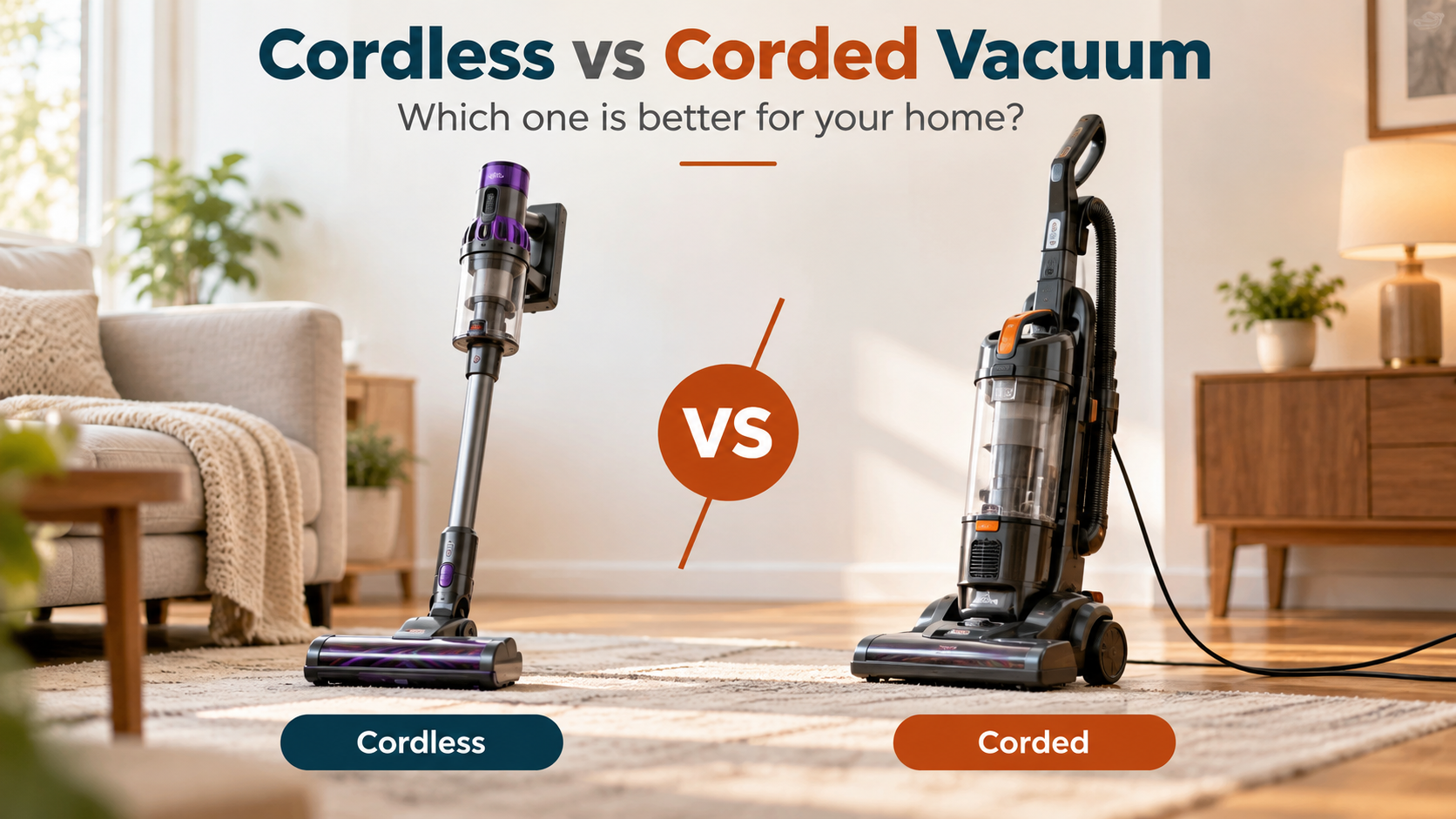

Walk into any home appliance store and you will see two kinds of vacuums competing for your attention: sleek cordless models that promise freedom, and traditional corded machines known for raw power. If you are trying to decide between them, you are asking one of the most common questions in home cleaning: cordless vs corded vacuum, which is better?
The honest answer is that it depends on your home, your floors and your habits. In this guide we compare both types in detail, covering suction, runtime, weight, cost, battery life and more, so you can choose with confidence.
Quick verdict
Choose a cordless vacuum if you want convenience, light weight and fast daily clean-ups in a small to medium home. Choose a corded vacuum if you want constant powerful suction, a larger dust capacity and the lowest cost for deep cleaning big spaces or thick carpets.
What Is a Cordless Vacuum?
A cordless vacuum runs on a rechargeable lithium-ion battery, so there is no cable tying you to a wall socket. Most are stick-style or handheld designs, and many can convert from a full-size stick vacuum into a handheld for stairs, upholstery and the car. You charge the battery on a dock or with a plug-in charger, and then clean until the battery runs low.
What Is a Corded Vacuum?
A corded vacuum plugs directly into a wall outlet and draws power continuously. This category includes upright vacuums, canister vacuums and corded stick models. Because power is never limited by a battery, these machines can deliver steady suction for as long as you need.

Cordless vs Corded Vacuum: Detailed Comparison
1. Suction Power
Corded vacuums have traditionally held the advantage here. A wall outlet provides steady, high power, so suction stays consistent from the first minute to the last. On thick carpet, embedded dirt and heavy pet hair, a good corded upright is hard to beat.
Modern cordless vacuums have narrowed the gap a lot. Premium models now offer strong suction that handles most everyday messes. The catch is that top suction is usually reserved for a boost mode that drains the battery quickly. As the battery weakens, performance can also drop slightly.
Winner: Corded for sustained deep-cleaning power. Cordless is good enough for most daily cleaning.
2. Runtime
This is the biggest difference. A corded vacuum has unlimited runtime, so you can clean the whole house without stopping. A cordless vacuum is limited by battery capacity. Most models run for roughly 20 to 60 minutes in standard or eco modes, but only about 8 to 15 minutes in max power mode.

For a small apartment, 30 minutes is usually plenty. For a large house, you may need to pause and recharge, or choose a model with a swappable battery.
Winner: Corded.
3. Weight and Maneuverability
Cordless vacuums are generally much lighter, often between 5 and 8 pounds, and they have no cable to tangle around furniture. They are easy to carry up stairs, slide under beds and use overhead on curtains or ceiling corners. Corded uprights are often 10 to 20 pounds, and you have to manage the cord and switch outlets as you move through the house.
Winner: Cordless.
4. Convenience and Storage
Convenience is where cordless vacuums really shine. You can grab one from the wall dock and clean up a spill in seconds, with no need to unwind a cable or find an outlet. Many take up very little floor space. Corded vacuums need more storage room and more setup time, which makes people less likely to use them for small messes.
Winner: Cordless.
5. Dust Bin Capacity
Corded vacuums usually have larger dust bins or bags, so you empty them less often. Cordless models keep the bin small to save weight, often around half a liter to one liter. That means more frequent emptying in a big home or when you have pets that shed heavily.
Winner: Corded.
6. Price and Long-Term Cost
Prices vary widely for both types. Budget corded vacuums can be found at very low prices, while premium cordless models can cost several hundred dollars. In general, you get more cleaning power per dollar with a corded vacuum.
Also remember the battery. Lithium-ion batteries wear out over time, typically after a few years of regular use, and replacement batteries can be expensive. A corded vacuum has no battery to replace, which can lower its long-term cost.
Winner: Corded for value.
7. Noise Levels
Both types make noticeable noise, and it depends more on the individual model than on the category. Cordless vacuums are often quieter in standard mode but get louder in boost mode. Some corded vacuums are noisy, while premium models include sound-dampening features. Check the decibel rating if noise matters to you.
Winner: Tie.
8. Performance on Different Floors
| Surface | Better Choice | Why |
|---|---|---|
| Hard floors (tile, wood, laminate) | Cordless | Light, quick and easy to maneuver with soft roller heads. |
| Low-pile carpet and rugs | Either | Both clean well with a good brush roll. |
| Thick or high-pile carpet | Corded | Steady suction pulls deeper dirt from the fibers. |
| Stairs and upholstery | Cordless | Lightweight and converts to a handheld. |
| Car interiors | Cordless | No need for an extension cord. |
| Heavy pet hair | Corded (or high-end cordless) | Larger bin and constant power handle hair better. |
Pros and Cons at a Glance
Cordless Vacuum
- Pros: lightweight, no cord, quick to grab, easy to store, great for stairs and cars, converts to handheld.
- Cons: limited runtime, smaller bin, battery wears out over time, higher price for strong performance.
Corded Vacuum
- Pros: unlimited runtime, consistent strong suction, larger capacity, no battery to replace, often better value.
- Cons: heavier, cord can limit reach and get in the way, takes more storage space, less convenient for quick clean-ups.
Which One Should You Choose?

Choose a cordless vacuum if:
- You live in a small to medium home or apartment.
- You prefer quick daily clean-ups over one long weekly session.
- You have mostly hard floors or low-pile rugs.
- You want to clean stairs, cars and tight spaces easily.
- You have trouble lifting or pushing heavy appliances.
Choose a corded vacuum if:
- You have a large home or lots of thick carpet.
- You want powerful, steady suction without worrying about battery life.
- You have multiple pets that shed heavily.
- You are on a tighter budget.
- You prefer a machine you can run for an hour without stopping.
Can You Own Both?
Many households find that the best answer is both. A corded upright or canister handles the weekly deep clean on carpets and large areas, while a cordless stick vacuum takes care of everyday crumbs, spills and pet messes. If your budget allows only one machine, pick the type that matches the cleaning you do most often.
What to Look for When Buying a Cordless Vacuum
- Battery runtime: look for at least 40 minutes in standard mode, and check the boost-mode runtime too.
- Removable or swappable battery: lets you extend runtime and replace the battery when it ages.
- Suction rating: compare air watts or pascals when manufacturers list them.
- Brush roll design: tangle-resistant brushes are a big help with pet hair and long hair.
- Dust bin size and easy emptying: a hygienic, no-touch release saves mess.
- Filtration: a sealed system with a HEPA-style filter helps allergy sufferers.
- Attachments: a crevice tool, dusting brush and upholstery tool add real value.
- Weight and balance: a lighter machine is easier to use for longer.
What to Look for When Buying a Corded Vacuum
- Cord length: a longer cable, ideally 25 feet or more, means fewer outlet changes.
- Suction control: adjustable settings protect delicate rugs and bare floors.
- Brush roll on/off switch: useful when moving between carpet and hard floors.
- Bagged or bagless design: bagged models can be cleaner to empty, while bagless models save on bag costs.
- Filtration: a sealed system with HEPA filtering captures fine dust and allergens.
- Weight and handling: a swivel head and light frame make a heavy machine easier to push.
- Reach: a long hose and attachments help with stairs and upholstery.
Tips to Get the Most From Your Vacuum
- Empty the bin often. A full bin lowers suction and strains the motor.
- Clean the filters. Rinse washable filters on schedule and let them dry fully.
- Remove tangled hair. Cut hair and threads from the brush roll regularly.
- Charge smartly (cordless). Avoid leaving the battery completely drained for long periods, and keep it away from extreme heat or cold.
- Use the right mode. Save boost mode for tough spots to protect cordless battery life.
- Store it properly. Keep your vacuum dry and, for cordless models, on its dock or in a cool place.
Common Myths About Cordless and Corded Vacuums
- “Cordless vacuums are weak.” Not anymore. Many modern models clean everyday messes very well, though they may not match the sustained power of a top corded machine.
- “Corded vacuums are outdated.” They remain a strong choice for deep cleaning, large homes and budget-conscious buyers.
- “Battery life is the same for every cordless model.” Runtime varies widely depending on the model, battery size and power mode.
- “A higher price always means better cleaning.” Features and brand also affect price. Match the specs to your needs rather than paying for extras you will not use.
Frequently Asked Questions
Is a cordless vacuum as powerful as a corded vacuum?
High-end cordless vacuums come close for everyday cleaning, but corded vacuums still offer stronger sustained suction, especially on thick carpets and in large homes.
How long do cordless vacuum batteries last?
Each charge typically lasts from about 20 to 60 minutes depending on the mode. Over the years, the battery slowly loses capacity, and most last roughly 2 to 5 years with regular use before needing replacement.
Are cordless vacuums good for pet hair?
Yes, especially models with tangle-free brush rolls and strong suction. For homes with several shedding pets, a larger bin and constant power from a corded model may be more practical.
Are corded vacuums cheaper?
Generally yes. You can usually get more suction and capacity per dollar with a corded vacuum, and there is no battery to replace.
Which is better for allergies?
Both types can work well if they have a sealed system and a HEPA-style filter. Look at the filtration rather than the power source.
Which type is better for a small apartment?
A cordless vacuum is usually the better fit. It is light, easy to store and convenient for quick clean-ups.
Which type is better for a large house?
A corded vacuum is often better because it never runs out of power and has a larger dust capacity. A cordless model with a swappable battery can also work.
Can a cordless vacuum replace my main vacuum?
For many small and medium homes, yes. Large homes with lots of carpet may still benefit from a corded vacuum for deep cleaning.
Final Verdict: Cordless vs Corded Vacuum
There is no single winner for everyone. Cordless vacuums win on convenience, weight and everyday usability, while corded vacuums win on power, runtime, capacity and value.
If your priority is fast, easy cleaning in a small or medium home, go cordless. If you want maximum suction for a big home, thick carpets or heavy pet hair at the best price, go corded. And if you can, combining both gives you the best of each world. Think about your space, your floors and how often you clean, and you will find the right vacuum for your home.