






Vacuum Cleaner Brush Roll Not Spinning? 7 Causes and Easy Fixes

You switch on your vacuum, push it across the carpet, and something feels wrong. The motor is roaring, the suction seems fine, but the carpet looks untouched and the brush roll is not spinning. It is one of the most common vacuum problems, and it can quietly ruin your cleaning results for weeks before you notice.
The good news is that a brush roll that will not spin is usually caused by something simple, such as a snapped belt or a wad of hair wrapped around the bar. This guide explains how the brush roll works, the seven most common reasons it stops turning, how to fix each one step by step, and how to stop it happening again. You will also find a diagnostic flowchart, a belt replacement walkthrough, and advice on when it is time to call a repair shop or buy a new machine.
Quick Answer: Why Is My Vacuum Brush Roll Not Spinning?
The most likely causes, roughly in order of how often they happen, are:
- Hair, string, or thread tangled around the brush roll or its end caps.
- A stretched, slipping, or broken drive belt (on belt-driven models).
- A jammed object such as a coin, a Lego brick, or a piece of carpet lodged in the brush chamber.
- The brush roll switch or floor mode turned off, or the vacuum set to hose or above-floor mode.
- Worn bearings or end caps that make the roll stiff or noisy.
- An overload protection cut-out or reset button that has tripped.
- An electrical or motor fault, including a failed switch, damaged cord, or worn motor.
Work through the sections below in order. Most people fix the problem with a pair of scissors or a new belt costing only a few dollars.
How a Vacuum Brush Roll Works
The brush roll, also called the beater bar or agitator, is the spinning cylinder in the floor head. Its job is to loosen dirt, hair, and debris from carpet fibers so the suction can carry it away. Without a spinning brush roll, a vacuum can still lift loose dust from a hard floor, but it struggles badly on carpet and rugs.
There are three common ways a brush roll is powered, and knowing which one you have tells you where to look first:

- Belt-driven: A rubber belt connects the motor shaft to the brush roll. This is the most common design on upright vacuums, and the belt is the most common failure point.
- Direct-drive: A small motor, often with gears, drives the brush roll without a belt. This is common on cordless stick vacuums and many modern uprights. Failures here are usually jams, worn gears, or electrical faults.
- Air-driven (turbine): Airflow through the head spins a small turbine that turns the brush. These are common on some budget and cylinder-vacuum attachments. If suction is weak, the brush will spin slowly or not at all.
Your manual or the model number on the label will tell you which type you have. If you are unsure, remove the base plate (after unplugging) and look for a belt loop.
Safety First Before You Start
Before you touch the brush roll, switch the vacuum off and unplug it. For cordless and robot vacuums, remove the battery if it is removable, or fully power the machine down. A brush roll can start spinning unexpectedly if the switch is knocked, and it may be hiding sharp objects such as staples, pins, or glass. Wearing thin work gloves is a sensible precaution. Never test the brush roll by hand while the vacuum is plugged in.
7 Common Reasons a Brush Roll Stops Spinning (and How to Fix Them)
1. Hair, String, or Thread Wrapped Around the Brush Roll
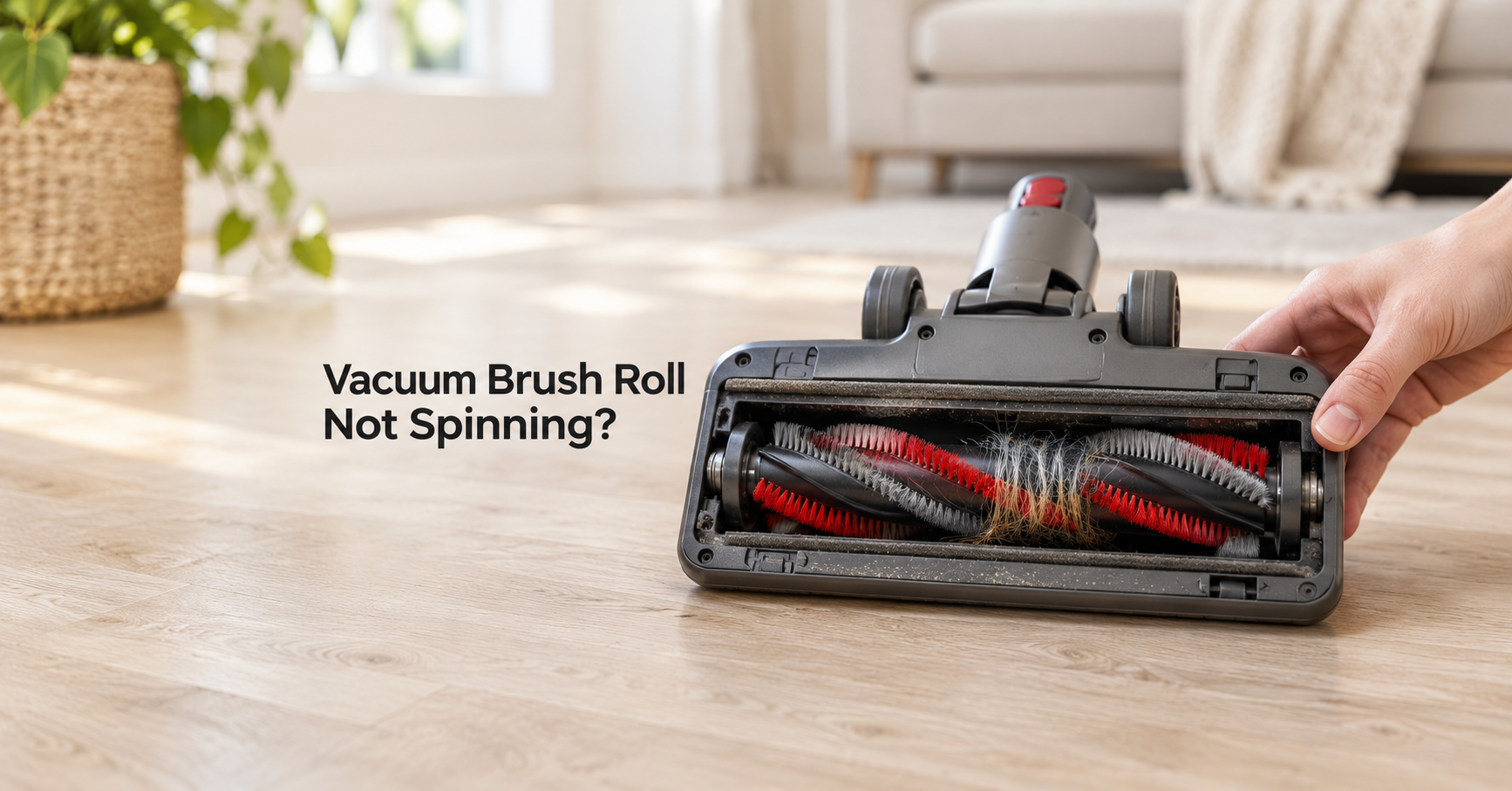
Why it happens: Long hair, pet fur, thread, and carpet fringe wind tightly around the roll. As the tangle grows it adds drag, slows the roll, and can eventually bind the end caps so the roll stops completely. On a belt-driven model, the tight tangle often causes the belt to slip or snap.
The fix:
- Turn the vacuum over and try spinning the brush roll by hand. If it is stiff or will not turn, a tangle is a likely cause.
- Cut along the hair with scissors or a seam ripper, taking care not to cut the bristles or the belt, then pull the cut pieces away.
- If your model lets you remove the brush roll, take it out and clear hair from both end caps and the shaft, since hair collects tightly at the ends.
- Check that the roll spins freely and quietly before you refit it.
2. A Jammed Object in the Brush Chamber
Why it happens: Coins, small toys, buttons, paper clips, and stones can wedge between the brush roll and the housing. A partial jam may only slow the roll, while a hard jam stops it completely and may trip the overload protection.
The fix:
- With the vacuum unplugged, open the base plate or brush cover and look carefully along the roll and the chamber.
- Remove any object by hand or with long-nose pliers. Check the intake channel behind the roll, which is another common place for items to lodge.
- Inspect the roll for damage such as a cracked end cap or a bent shaft, which can cause it to catch again.
3. A Stretched, Slipping, or Broken Belt
Why it happens: The rubber belt that drives the brush roll wears out with heat and use. It stretches until it slips, cracks, or snaps. When a belt breaks, the motor still runs and suction is normal, but the brush roll stays still. A slipping belt can also produce a hot rubber smell or a squealing noise.
The fix:
- Unplug the vacuum, open the base plate, and look at the belt. A belt that is loose, shiny, frayed, cracked, or snapped needs replacing.
- Buy a replacement made for your exact model number. Belts are not interchangeable between models.
- Follow the belt replacement guide below. As a rough guide, many belts last around six to twelve months depending on use, but this varies a lot.
4. The Brush Switch or Floor Mode Is Turned Off
Why it happens: Many vacuums let you turn off the brush roll for hard floors or delicate rugs. Others automatically stop the brush when you lower the handle to hose mode or switch to above-floor cleaning. Sometimes the switch is simply knocked by accident, or the machine has been left in hard floor mode.
The fix:
- Check for a brush roll on/off switch on the handle or the floor head, and make sure it is in the on position.
- Make sure the vacuum is upright and set to floor mode, not hose or tool mode. Many uprights have a pedal or a diverter that must be set correctly.
- If your model has a height adjustment, check that it is not set too high for the floor type, since some designs only spin the brush when the head is in contact with the floor.
5. Worn Bearings or End Caps
Why it happens: The ends of the brush roll turn on small bearings or plastic bushings. Over time, dust and hair work into them, and they wear out. A worn bearing causes a grinding or squeaking noise, makes the roll stiff, and generates heat. Eventually the roll can seize.
The fix:
- Remove the brush roll and spin it by hand. It should rotate smoothly and quietly. A gritty feeling, wobble, or noise means the bearings or end caps are worn.
- Clean the ends thoroughly to remove packed hair and dirt. Sometimes this alone brings the roll back to life.
- If the roll is still stiff, replace the end caps or the whole brush roll. Most manufacturers sell replacements for specific models.
- Avoid oiling the bearings unless your manual tells you to, because oil attracts dust and can make things worse.
6. Overload Protection or a Tripped Reset Button
Why it happens: Many vacuums have a safety cut-out that protects the motor and belt when the brush roll jams. On some belt-driven models, a clutch or a reset switch stops the brush when it detects a jam. If this has tripped, the brush roll will not spin until the cause is cleared and the protection is reset.
The fix:
- Clear any jam or tangle first, as covered in the sections above.
- Look for a reset button on the floor head or body, often a small red or labeled button, and press it as described in your manual.
- Let an overheated vacuum cool for at least 30 to 45 minutes before using it again, and make sure the filters are clean so the motor is not struggling.
7. A Faulty Switch, Wiring, Battery, or Motor
Why it happens: If you have ruled out all of the causes above, the problem may be electrical. A failed brush switch, damaged wiring in the cord or floor head, a worn motor, or a weak battery on a cordless model can all prevent the brush from spinning even though everything looks fine mechanically.
The fix:
- Check the power cord and plug for damage. Never use a vacuum with a frayed or cracked cord.
- On cordless and robot vacuums, charge the battery fully and clean the charging and brush contacts. Many models reduce power to the brush when the battery is low.
- If the brush roll motor in the floor head hums but does not turn, or does not make any sound at all, the motor or its wiring may be at fault.
- Electrical repairs are best left to a qualified technician. If the vacuum smells of burning or cuts out repeatedly, stop using it.
Brush Roll Diagnostic Flowchart
If you would rather follow a simple process, use the flowchart below. Start at the left and answer each question in order.

How to Replace a Vacuum Belt Step by Step
If your belt is stretched or broken, replacing it is one of the easiest repairs you can do at home. The exact steps vary by model, so always follow your manual, but the process is usually very similar.

- Unplug the vacuum and lay it flat or on its back so you can reach the underside.
- Remove the base plate or brush cover. This is usually held by clips, a coin-turn fastener, or a few screws.
- Lift out the brush roll and slip off the old belt. Note how the belt was fitted before you remove it.
- Clean the parts. Remove hair from the end caps, the brush roll shaft, and the motor pulley. Check the old belt for signs of why it failed, such as heavy hair build-up or a jam.
- Fit the new belt. Loop it around the motor shaft first, then stretch it over the brush roll pulley. Make sure it sits flat and is not twisted.
- Refit the brush roll and cover, plug in the vacuum, and check the brush roll spins freely and evenly.
Always use a belt matched to your model. A belt that is too loose will slip, and one that is too tight can strain the motor and bearings.
Troubleshooting by Vacuum Type
| Vacuum Type | Most Likely Causes | First Thing to Check |
|---|---|---|
| Upright (belt-driven) | Snapped or stretched belt, hair tangle, jam | The belt and brush roll by hand |
| Upright (direct-drive) | Jam, worn gears, tripped overload protection | Reset button and brush chamber |
| Cordless stick | Hair wrapped around the roll, low battery, dirty contacts | Roller ends and battery charge |
| Canister with power head | Belt failure, faulty power head connection, jam | Power head contacts and belt |
| Robot vacuum | Tangled main brush, jammed side brush, dirty gears | Brush ends and bearings |
| Air-driven attachment | Weak suction, blocked air path, dirty turbine | Filters and hose for blockages |
Special Cases
Brush Roll Spins Slowly or Intermittently
A brush roll that spins slowly, hesitates, or only works sometimes is usually a worn or loose belt, partly tangled hair, or a stiff bearing. On cordless models it can also mean a low battery. Clean the roll and ends, check the belt, and charge the battery fully.
Brush Roll Spins but Does Not Clean Well
If the roll turns but your carpet still looks dirty, the bristles may be worn flat, the height setting may be wrong, or suction may be weak because of a full bin or clogged filter. Check the bristles for wear and look at the filters and hose for blockages.
Brush Roll Makes Noise but Does Not Turn
A humming or clicking sound with no movement points to a jammed roll, a failed belt that is still slipping on the pulley, or a worn gear. Switch off immediately, because running the motor against a jam can overheat it. Unplug the vacuum and inspect the brush chamber.
Brush Roll Burning Smell
A hot rubber smell is typically caused by a belt slipping against a tangled or jammed roll. Stop using the vacuum, let it cool, and clear the jam. Replace the belt, since a belt that has overheated is usually damaged. If you also notice smoke or an electrical smell, do not use the machine again until it has been checked.
How to Prevent Brush Roll Problems
A few small habits will keep the brush roll turning reliably for years:
- Cut away hair every week or two. Households with long hair or pets may need to do it after each few uses.
- Pick up string, threads, coins, and small toys before you vacuum.
- Check the belt every few months and replace it at the first sign of cracking or stretching, before it breaks.
- Keep filters and the dust bin clean so the motor does not overheat and the airflow stays strong.
- Do not vacuum fringe, rug tassels, or loose threads with the brush roll on. Switch it off or use an attachment.
- Keep a spare belt that matches your model so a break never leaves you without a working vacuum.
When to Repair and When to Replace
| Situation | Usually Best Choice |
|---|---|
| Hair tangle, jam, switch set to off | Fix it yourself at no cost |
| Stretched or snapped belt | Replace the belt, an inexpensive repair |
| Worn bristles, damaged end caps, stiff bearings | Replace the brush roll or end caps |
| Failed motor, gearbox, or wiring in an otherwise good machine | Professional repair if the cost is reasonable |
| Older machine with repeated faults and repair costs close to a new price | Replace the vacuum |
What to Look for in a Replacement Vacuum
If it is time for a new machine, these features reduce the chance of brush roll trouble in the future:
- Anti-tangle brush design: Look for rolls designed to resist hair wrapping, which is especially valuable in homes with pets or long hair.
- Easy brush roll access: A roll that can be removed quickly without tools makes regular cleaning far easier.
- Brush on/off control: This is useful for switching between carpet and delicate hard floors.
- Jam protection: A reset button or automatic cut-out protects the motor and belt if the roll is blocked.
- Parts availability: Choose a brand that sells belts, brush rolls, and filters for your model for many years.
- Floor type match: Strong agitation suits thick carpet, while soft rollers suit hard floors.
Frequently Asked Questions
Why is my vacuum brush roll not spinning but the suction works?
The suction and the brush roll are powered separately on many models. If suction works but the roll is still, the most likely causes are a broken belt, a tangle or jam, a switch set to off, or a tripped overload protection.
How do I know if my vacuum belt is broken?
Unplug the vacuum and open the base plate. A broken belt will be snapped, hanging loose, or missing from the pulleys. A stretched belt will look loose, shiny, or cracked and may slip on the roll. If the brush roll turns easily by hand but does not spin when the vacuum is on, the belt is a likely cause.
How often should I replace the vacuum belt?
There is no fixed rule, because it depends on the model and how often you vacuum. Many people replace belts every six to twelve months, and sooner if they use the vacuum heavily or vacuum up a lot of hair. Inspect it regularly and replace it when you see wear.
Can I use a universal belt?
It is best to use a belt made for your exact model. Belt length, width, and shape matter, and a poor fit can slip, wear quickly, or strain the motor. Check your model number before buying.
Why does my brush roll keep stopping?
A brush roll that stops repeatedly is usually triggering overload protection because of a tangle or jam, or it is being slowed by a worn belt or stiff bearing. Clear the roll, check the belt, and clean the filters so the motor is not overheating.
Is it safe to run a vacuum with the brush roll not spinning?
It will not usually be dangerous, but the vacuum will clean carpet poorly and the motor may strain if there is a jam. If you smell burning or hear grinding, stop using it. Fix the cause before continuing.
Why does my cordless vacuum brush roll not spin?
The most common reasons are hair wrapped around the roll, a jammed object, a low battery, or dirty contacts between the brush head and the main body. Clean the head, charge the battery, and make sure the head is fitted firmly.
Final Thoughts
A vacuum brush roll that is not spinning is rarely a sign that your machine is finished. In most cases it is a tangle, a jam, a switch, or a worn belt, all of which you can solve at home in minutes with simple tools. Start with the easiest checks, work through the diagnostic steps, and replace worn parts with ones made for your exact model.
Keep up a quick routine of clearing hair, checking the belt, and keeping your filters clean, and your brush roll will keep turning and your carpets will stay noticeably cleaner. If the machine is old, noisy, or has electrical problems that keep coming back, a new vacuum with an anti-tangle design and easy-access brush roll can save you a lot of frustration.