







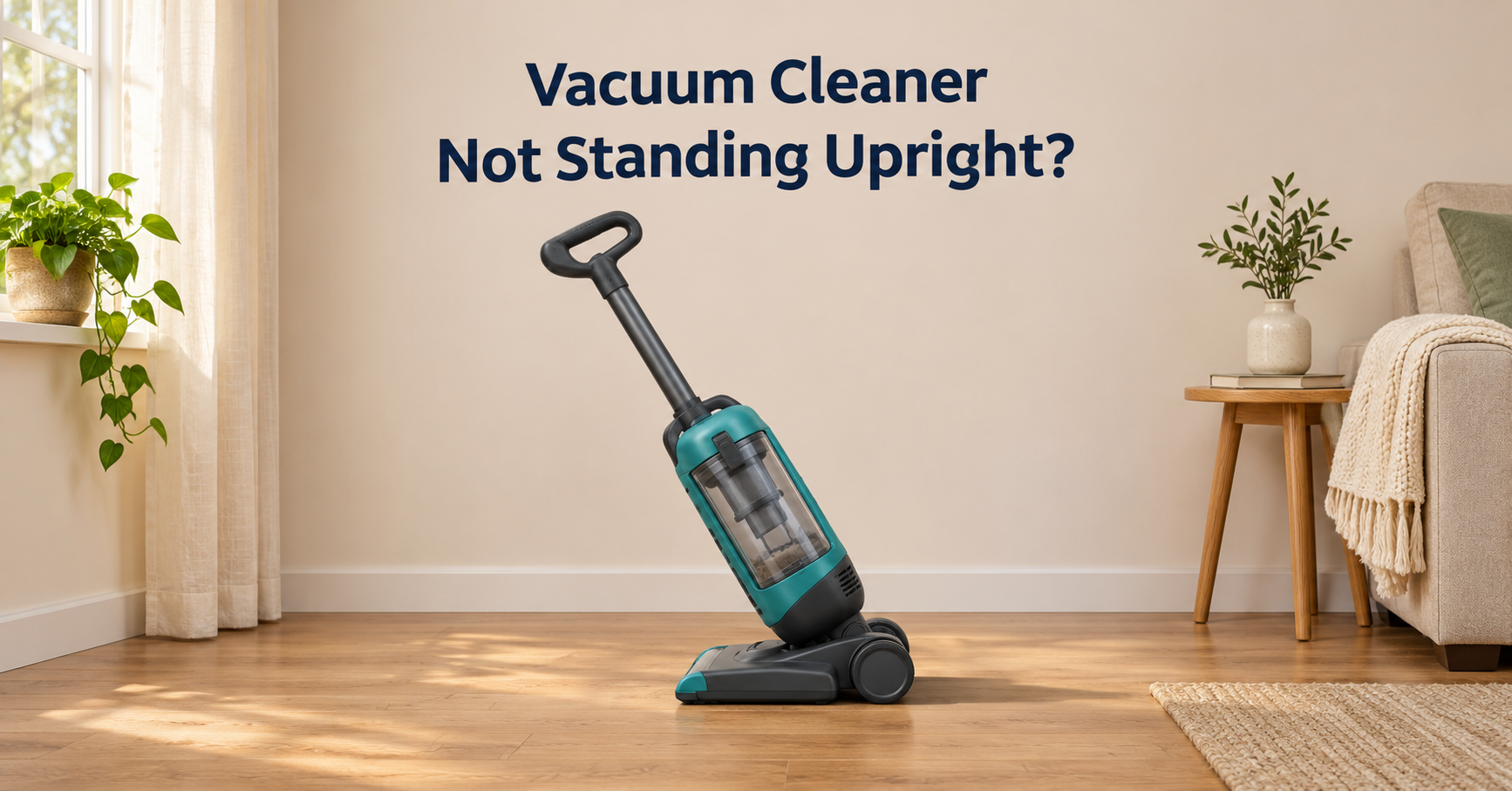
You finish cleaning, park your upright vacuum, and it falls backward onto the floor. If your vacuum cleaner is not standing upright, it is annoying and a little worrying, because the handle can bang into furniture or strain the hose. Fortunately, the cause is usually a small latch, spring or pedal that you can fix at home. This guide shows you the reasons, simple fixes, and what to look for in a better model.
Quick answer
An upright vacuum usually will not stand because the handle latch, release pedal or tension spring is dirty, worn or broken. Unplug it, clean the pedal area, tighten screws, check that the handle clicks into the upright position, and replace the worn latch or spring if needed.
10 reasons your vacuum cleaner will not stand upright (and how to fix each one)
1. The handle latch or lock is worn
Most upright vacuums have a plastic latch that holds the handle in the vertical position. Over time it wears, cracks or loses its grip, so the handle falls back. Push the handle up and listen for a click. If there is none, the latch hook or its seat needs cleaning or replacement.
2. The release pedal is stuck or dirty
The foot pedal that releases the handle can fill with dust, hair and crumbs. It then stays half pressed and the handle never locks. Unplug the vacuum, clean around the pedal with a soft brush, and work it by hand a few times to see that it springs back.
3. A tension spring has broken or weakened
A small internal spring pushes the latch into place. If it stretches or snaps, the lock does not engage. You can often see or feel the missing resistance when you press the pedal. This is a cheap part to replace on most models.
4. The hose or an attachment is pulling the vacuum over
An attached hose, wand or heavy accessory can shift the center of gravity and tip the machine backward. Clip the hose into its holder, store accessories on the body, and remove extra attachments before you park the vacuum.
5. The dust cup or bag is too full or badly seated
A full or loose canister makes the top heavy, and a badly seated one puts stress on the handle area. Empty it, check that it clicks in properly, and make sure the filters are fitted correctly.
6. A cracked body, pivot joint or screw is loose
Where the handle meets the base, plastic can crack and screws can back out. Check for cracks, play or a gap when you wiggle the handle. Tighten loose screws, and replace a cracked pivot piece, since a glued repair rarely holds.
7. The brush roll or wheels do not sit properly
A jammed brush roll, a bent axle or a wheel that has slipped off can tilt the base. Make sure the wheels spin, the brush roll turns freely and the base sits flat on the floor.
8. The floor is uneven or soft
Thick rugs, carpets and slightly sloping floors make an upright vacuum lean. Park it on a hard, level surface, away from stairs and thresholds.
9. It is a stick or cordless vacuum with no free-standing design
Many stick and handheld cordless models are made to lean on a wall or dock, not to stand alone. This is normal, so use the supplied dock or a wall mount instead of expecting it to stand on its own.
10. The handle assembly was not put together correctly
After assembly or cleaning, the handle tube, locking collar or hose may be out of alignment. Take the handle off, check the instruction manual and refit it until all parts click into place.
Step-by-step fix
- Switch off and unplug the vacuum, or take out the battery.
- Empty the dust cup or bag, and unhook the hose and attachments.
- Stand the vacuum on a hard, level floor and push the handle upright until you hear a click.
- Press the release pedal by hand a few times and clear dust, hair and crumbs around it.
- Look inside the handle joint for a broken latch, a missing spring or a cracked pivot piece.
- Tighten any loose screws with the correct screwdriver, without over-tightening.
- Replace the damaged latch, spring or handle collar with a part made for your model.
- Test it again on a flat surface. If it still falls, repair service or replacement is the best choice.
How to keep your vacuum standing upright
- Clean the pedal and latch area every month with a brush.
- Do not stomp the release pedal too hard, since this wears the latch.
- Park it on a hard, level surface and not on a thick rug.
- Clip the hose and tools in place to keep the weight balanced.
- Empty the bin often so it does not become top heavy.
- Do not pull it by the hose or handle when moving it.
Stick and cordless vacuums that cannot stand alone
If your cordless stick vacuum leans or falls, it may not be faulty at all. Many are designed to rest on a charging dock or wall mount. Use the dock, or buy a floor stand or wall bracket that fits your model. Some newer designs include a free-standing base, and this is a handy feature if you do not have wall space.
Repair or replace?
- Repair if the part is cheap, such as a latch, spring or screw, and the vacuum otherwise works well.
- Replace if the housing is cracked, the pivot is damaged, parts are not available, or repair costs are close to the price of a new one.
- Replace if the vacuum is old and also has weak suction, a bad battery or motor trouble.
Features to look for in a vacuum that stands upright reliably
- Metal or reinforced handle lock in place of thin plastic.
- Wide, stable base and a low center of gravity.
- Free-standing design for cordless stick models.
- Handle and hose storage that keeps accessories on the body.
- Replaceable parts and a long warranty.
- Balanced weight distribution with a well-seated dust cup.
- Easy-release pedal that is large and easy to clean.
Frequently asked questions
Why does my vacuum cleaner fall backward when I let go?
The handle latch is probably not locking. Check the release pedal for dirt, and the latch, spring and pivot for wear or damage.
Can I fix a vacuum that will not stay upright myself?
Often yes. Cleaning the pedal, tightening screws and replacing a small latch or spring are simple jobs for many people. Always unplug the vacuum first.
How much does it cost to repair the upright lock?
A replacement latch or spring is usually inexpensive, while a cracked housing can cost more than the vacuum is worth on older models.
Do all vacuums stand on their own?
No. Upright vacuums with a locking handle are designed to stand, but most stick and handheld vacuums need a dock, wall mount or leaning support.
Is it safe to keep using a vacuum that will not stay upright?
It still works, but a loose handle can strain the hose and cord and may cause the machine to tip. Fix the lock when you can.
Final thoughts
A vacuum cleaner that will not stand upright is nearly always a small mechanical issue. Clean the release pedal, check the latch and spring, and make sure nothing is pulling on the handle. If the housing is damaged or the machine is old, replacing it with a model that has a solid lock and a stable base will save you time and frustration.
Disclosure: this site may earn a commission from qualifying purchases at no extra cost to you.