



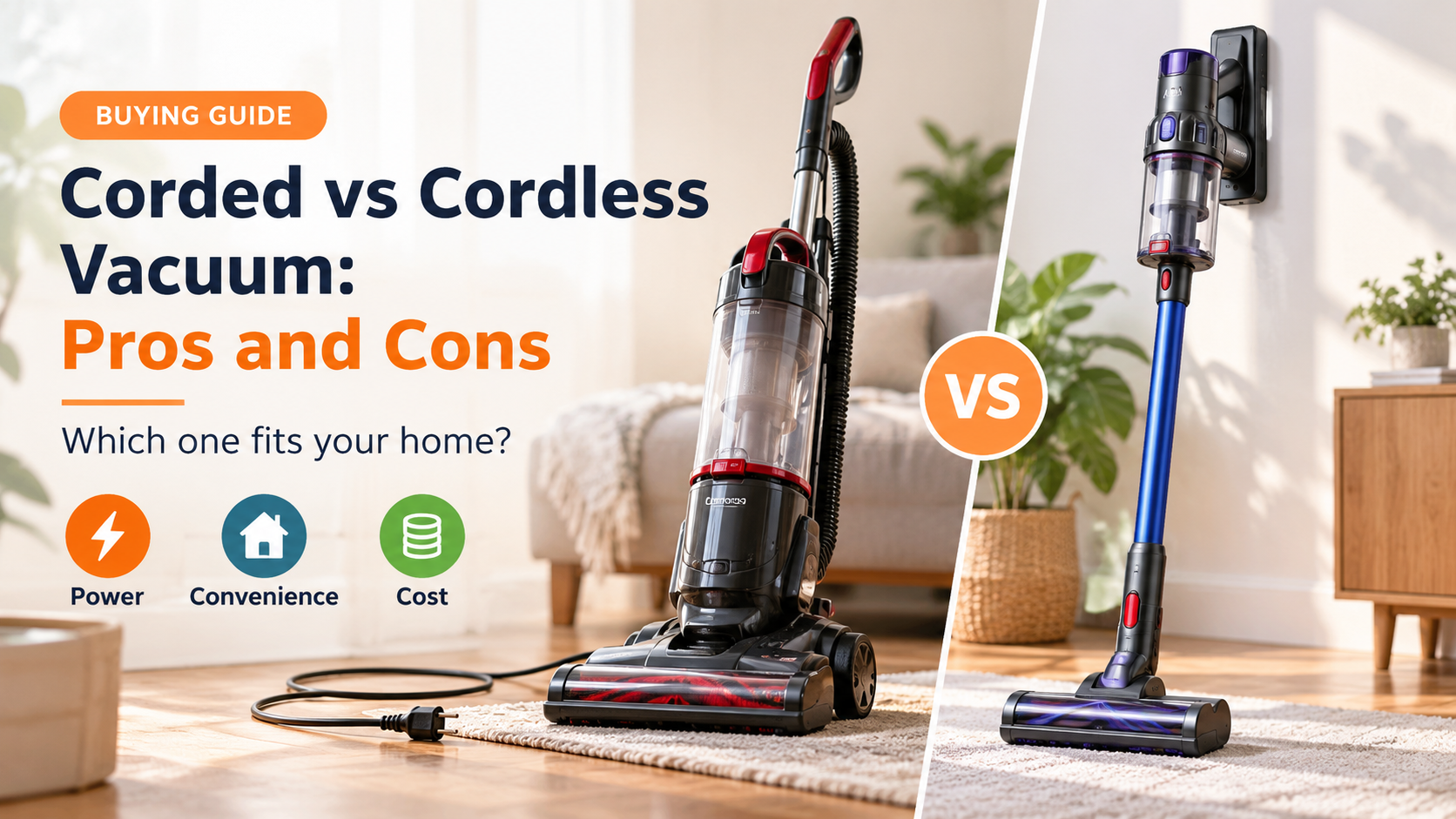

Buying a new vacuum used to be simple: you picked one that plugged into the wall. Today, battery technology has improved so much that cordless models are everywhere, and many shoppers are stuck on one big question: should I buy a corded or a cordless vacuum?
The honest answer is that both types have real strengths and real weaknesses. A corded vacuum gives you steady power and unlimited cleaning time at a lower price. A cordless vacuum gives you freedom, speed and convenience, but with limits on battery life and bin size. This guide breaks down the corded vs cordless vacuum pros and cons in plain language so you can match the right machine to your home, your floors and your budget.
Quick Verdict: Corded vs Cordless Vacuum
- Choose corded if you have a larger home, a lot of thick carpet, a tighter budget, or you want the most cleaning power for your money.
- Choose cordless if you have a small or medium home, mostly hard floors or low-pile carpet, and you value quick, effortless clean-ups and easy storage.
- Consider both if you can: a corded vacuum for weekly deep cleaning and a cordless one for daily mess.
What Is a Corded Vacuum?
A corded vacuum draws power directly from a wall socket through a power cable. This category includes upright vacuums, which are popular for carpets, and canister (cylinder) vacuums, which have a separate body that you pull behind you and a flexible hose with a wand. Because the machine is powered by mains electricity, it can run at full strength for as long as you like.
What Is a Cordless Vacuum?
A cordless vacuum runs on a rechargeable battery, usually lithium-ion. The most common type is the stick vacuum, a slim, lightweight machine that often converts into a handheld for cars, stairs and upholstery. There are also small handheld vacuums for quick spills. Since there is no cord, you can move freely around your home, but you are limited by how long the battery lasts.
Corded vs Cordless Vacuum at a Glance

The table above shows the main trade-offs. Corded machines generally lead on power, run time, bin size, price and lifespan. Cordless machines lead on weight and convenience. The sections below explain each point in more detail.
Corded Vacuum Pros and Cons
Corded Vacuum Pros
- Unlimited run time. As long as it is plugged in, a corded vacuum keeps going. You can clean a whole house in one go without worrying about a battery running out halfway through.
- Strong, consistent suction. Mains power delivers steady performance on every setting. In independent consumer testing, corded models have on average picked up noticeably more dirt from carpet than cordless models, which makes them a safer choice for deep-pile rugs and wall-to-wall carpeting.
- Larger dust bin or bag. Corded vacuums typically hold a couple of liters of dirt, so you empty them less often. That matters in bigger homes and in households with pets.
- Lower price. For the same cleaning power, a corded vacuum usually costs less than a cordless one, because you are not paying for an expensive battery.
- Longer lifespan. With no battery to wear out, a well-maintained corded vacuum can last around eight to ten years or more.
- No charging. It is always ready to go, which suits people who forget to charge things.
Corded Vacuum Cons
- The cord limits your reach. You need to stay within range of a socket, so you will unplug and replug as you move from room to room. Long cords help, but they can also tangle or become a trip hazard.
- Heavier and bulkier. A typical upright can weigh roughly 10 to 20 pounds (about 4.5 to 9 kg), which makes carrying it up and down stairs tiring.
- Less convenient for quick jobs. Pulling out a full-size vacuum and a cable for a few crumbs can feel like too much effort, so people may clean less often.
- Harder to store. Uprights and canisters take up more space in a closet or cupboard.
- Awkward for cars, ceilings and tight spots. Unless it has a long hose and good attachments, a corded vacuum is less handy for these jobs.
Cordless Vacuum Pros and Cons
Cordless Vacuum Pros
- Grab-and-go convenience. No cord means no hunting for sockets. You can clean up a spill in seconds, which makes it easier to keep floors tidy every day.
- Lightweight and easy to maneuver. Many cordless models weigh only a few pounds, often around three kilograms on average. That makes them easier to use on stairs and for people who find heavier machines tiring.
- Versatile. Many cordless sticks turn into a handheld vacuum, so one machine can handle floors, stairs, sofas, car seats, curtains and shelves.
- Easy to store. Slim bodies fit in small closets, and many come with a wall dock that also keeps the battery charged.
- No tripping hazard. There is no cable to snag on furniture or catch around your feet.
- Improving performance. The best cordless models today can come close to corded performance on many surfaces, especially hard floors.
Cordless Vacuum Cons
- Limited battery life. Many cordless vacuums run for roughly 15 to 60 minutes per charge, and the figure drops sharply in the strongest power mode, sometimes to under 10 or 20 minutes. Larger homes may need a recharge or a spare battery before you finish.
- Smaller dust bin. Cordless bins are often under a liter, so you will empty them more often and may need to clean filters more frequently.
- Battery wear. Lithium-ion batteries gradually lose capacity. Over time, a cordless vacuum runs for less time per charge, and eventually the battery may need to be replaced. Cordless models are often said to last around three to five years before the battery becomes a concern.
- Higher price for the same power. Good cordless vacuums can cost considerably more than corded ones with similar cleaning ability.
- Power can vary. Budget cordless models in particular may struggle with deep carpet and ground-in dirt.
- Recharging takes time. If the battery is flat, you may have to wait a few hours before you can use it again.
Pros and Cons Summary

Head-to-Head: How They Compare in Real Life
Suction Power and Cleaning Performance
Corded vacuums have the advantage here, especially on carpet. Mains power gives a steady, strong airflow that is good at lifting dirt buried in carpet fibers. Cordless vacuums have improved a lot, and the best ones clean hard floors very well, but they tend to be less consistent on thick carpet, and weaker budget models can leave dirt behind.
One tip: be careful with suction numbers. Brands measure suction in different ways, such as air watts, pascals or motor wattage, so you cannot compare figures across brands. Motor wattage in particular tells you how much electricity the motor uses, not how well the machine actually cleans. Reviews and independent tests are a better guide than numbers on a box.
Run Time and Battery Life
A corded vacuum has no run time limit. A cordless vacuum does, and the number printed on the box usually refers to the lowest power setting. In everyday use, with a motorized brush head and a higher power mode, you will often get far less. If you have a large home, check whether the battery is removable so you can swap in a spare.
Weight and Maneuverability
Cordless wins clearly. Lighter machines and no cord make a big difference on stairs, in tight rooms and for anyone who finds heavy equipment difficult. Keep in mind that a cordless stick puts all its weight in your hand when you clean above floor level, such as curtains or ceilings, so check how it feels in use.
Dust Bin Size and Maintenance
Corded vacuums usually have bins or bags several times larger than cordless models, so you empty them less often. A small cordless bin means more frequent trips to the trash, and a full bin or clogged filter reduces performance. Whichever you choose, wash or replace filters as the manufacturer recommends.
Noise
Both types vary widely. Cordless vacuums running at high power can be loud and high-pitched, while some corded models are deep and heavy-sounding. If noise matters to you, read reviews that test it rather than relying on specifications alone.
Cost and Long-Term Value
Corded vacuums generally offer more cleaning power per dollar. Cordless vacuums cost more up front, and you may eventually pay for a replacement battery. Still, if you vacuum more often because a cordless model is so easy to use, the extra cost can feel worthwhile.
Durability and Lifespan
Corded vacuums often last longer because they have fewer wear-prone parts. Lithium-ion batteries are usually rated for hundreds to a thousand or more charge cycles, which can mean several years of regular use, but their capacity fades gradually. Good care helps extend battery life.
Pet Hair and Allergies
For homes with shedding pets, a larger bin and powerful brush on a corded model help with heavy hair, while a cordless handheld is ideal for sofas and stairs. For allergy sufferers, look for sealed filtration and a washable or high-efficiency filter, and empty the bin outdoors or into a bag to avoid releasing dust. Smaller cordless bins need emptying more often, so keep that in mind.
Which One Should You Choose?

Best for Large Homes and Thick Carpet: Corded
If you have a big house, many rooms or a lot of carpet, a corded vacuum gives you the run time and bin size to get the job done in a single session. A corded upright is a very good fit for wall-to-wall carpeting.
Best for Small Homes and Apartments: Cordless
For a small space with mostly hard floors, a cordless stick can handle the whole home on one charge and is easy to store. It also encourages quick daily clean-ups, which often keeps the home cleaner overall.
Best for Pet Owners
A corded vacuum is better for deep-cleaning pet hair out of carpet. A cordless model is better for daily upkeep. Many pet owners find a combination ideal.
Best for Stairs and Tight Spaces
Cordless wins thanks to its light weight, lack of a cord and handheld mode.
Best on a Budget
Corded wins. You get more cleaning power for your money, and you avoid battery replacement costs.
Best for People With Limited Strength or Mobility
Cordless models are generally easier to carry, and no cord means no bending to plug and unplug. Check the weight and balance of the specific model, though, since some cordless vacuums are heavier than others.
Why Not Own Both?
Many households use a corded vacuum for a weekly deep clean and a cordless one for daily spills and quick tidy-ups. If you can afford only one, choose the type that matches the floors you clean most.
Buying Checklist: What to Look For

- Real run time (cordless): check the run time on the normal setting, not boost mode.
- Battery type (cordless): a removable battery lets you carry a spare and replace the pack when it wears out.
- Dust bin size: a bigger bin means fewer interruptions.
- Weight and balance: try to judge how heavy it feels, especially if you have stairs.
- Brush head and attachments: choose a brush that suits your floors and tools for pet hair, corners and upholstery.
- Filtration and noise: look for a well-sealed filter, particularly if anyone in the home has allergies.
- Cord length (corded): a longer cord means fewer socket changes. Look for one that reaches across a whole room.
- Warranty and spare parts: a longer warranty and easy-to-find replacement batteries and filters add peace of mind.
How to Make Your Vacuum Last Longer
Cordless Battery Care
- Use the charger that came with the vacuum, or one made for it.
- Do not leave the battery completely flat for long periods, as that can damage it.
- Avoid charging or storing it in very hot or very cold places.
- Use the lowest power mode that does the job, and save boost mode for stubborn dirt.
- Keep a spare battery if your model allows it.
General Care for Any Vacuum
- Empty the bin before it is completely full.
- Wash or replace filters regularly, following the manufacturer’s instructions.
- Cut away hair and threads wrapped around the brush roll.
- Check hoses and wands for blockages if suction drops.
- For corded models, wind the cable loosely and avoid yanking the plug out by the cord.
Common Myths About Corded and Cordless Vacuums
- “Cordless vacuums cannot clean carpet.” Not true. The best models do a good job on many carpets, but weaker ones struggle with thick pile.
- “Corded vacuums are outdated.” Not true. They remain the strongest value for deep cleaning and long sessions.
- “More watts means more suction.” Not necessarily. Watts show how much power the motor uses, not how well it cleans.
- “A cordless vacuum will last as long as a corded one.” Usually not. The battery is the part most likely to wear out first.
Frequently Asked Questions
Is a corded or cordless vacuum better?
Neither is better in every situation. Corded vacuums are usually better for power, run time, bin size and price. Cordless vacuums are better for convenience, light weight and storage. The best choice depends on the size of your home and the floors you have.
Are cordless vacuums as powerful as corded ones?
The best cordless vacuums come close on many surfaces, especially hard floors, but corded vacuums are usually stronger on thick carpet and more consistent across the whole cleaning session.
How long do cordless vacuum batteries last?
Run time per charge is commonly 15 to 60 minutes, depending on the model and power mode. Over the long term, lithium-ion batteries are generally rated for hundreds to over a thousand charge cycles, so they may last several years, but their capacity fades with use.
Can a cordless vacuum be my only vacuum?
Yes, if you have a small or medium home, mostly hard floors or low-pile carpet, and a model with enough battery life and a decent bin. Large homes or thick carpet may need a corded model.
Are corded vacuums cheaper?
In general, yes. For a similar level of cleaning power, a corded vacuum usually costs less than a cordless one.
Which vacuum is best for pet hair?
A corded vacuum with a powerful brush and a large bin is great for deep cleaning, while a cordless handheld or stick is convenient for daily pickups. Many pet owners benefit from using both.
Do cordless vacuums lose suction over time?
The motor itself may stay strong, but a worn battery cannot deliver power for as long, and a full bin or clogged filter will also reduce suction. Regular cleaning and good battery care help.
Is a cordless vacuum worth the extra money?
It can be, if you value convenience and you will use it more often because of it. If your main goal is the most cleaning power for the lowest price, a corded model is usually better value.
Final Verdict
In the corded vs cordless vacuum debate, there is no single winner. Corded vacuums win on suction consistency, unlimited run time, bin size, price and lifespan. Cordless vacuums win on weight, convenience, storage and versatility. Think about the size of your home, the type of floors you have, and how you like to clean. If you want power and value, go corded. If you want convenience and quick clean-ups, go cordless. And if you want the best of both, use one of each.
Disclaimer: Figures such as run time, weight, bin size and lifespan are typical ranges and vary by model, price and usage. Always check the specifications and warranty of the specific product you plan to buy.