


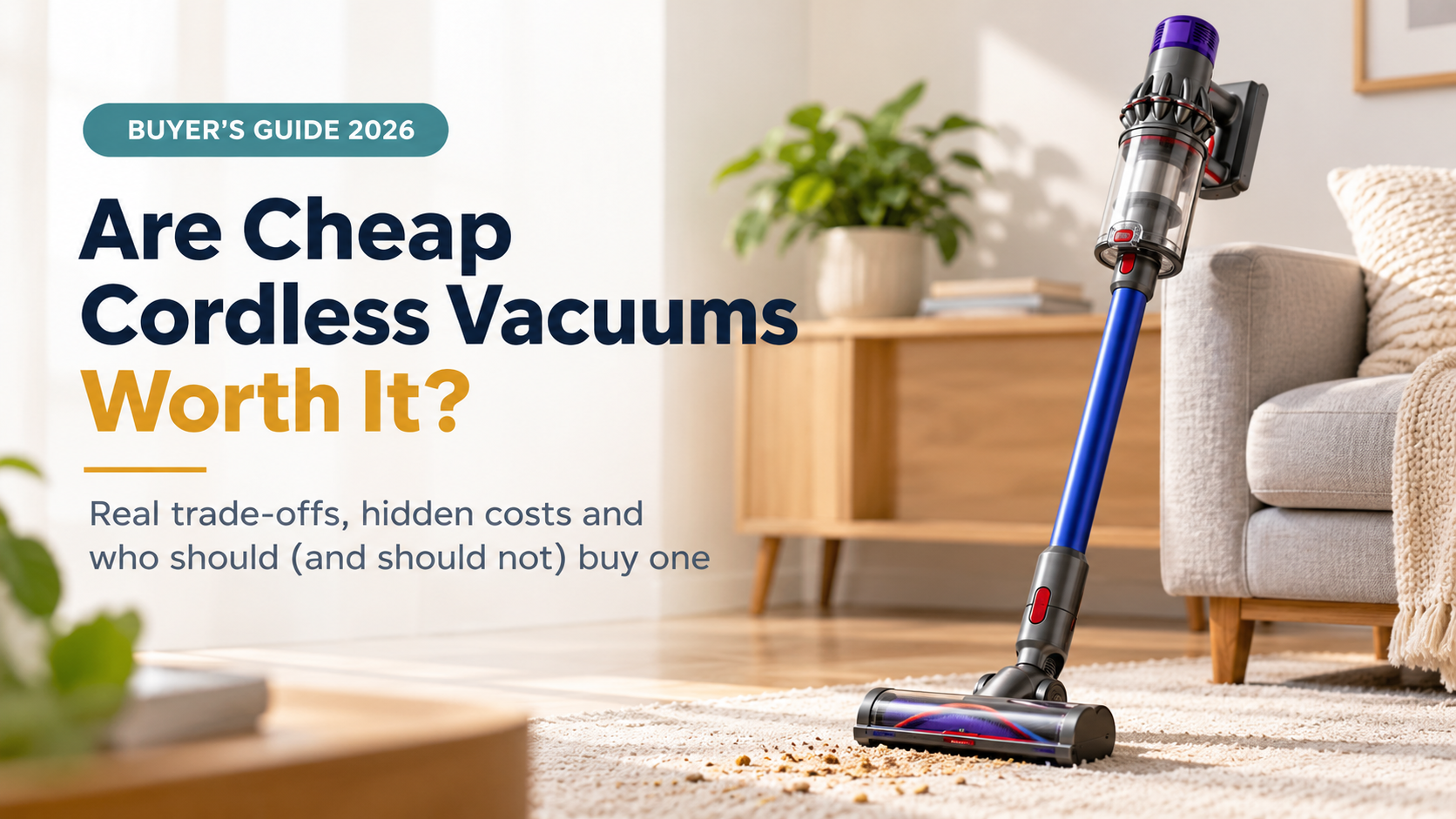
You have seen them everywhere: sleek stick vacuums priced at a fraction of the big-name models. They promise suction, freedom from cords and a clean floor in minutes. But a price tag that low makes most people pause and ask the obvious question: are cheap cordless vacuums worth it, or are you just buying a problem for later?
The honest answer is that it depends on your home, your habits and what you expect from the machine. In this guide we break down what you really get at a low price, what you give up, what it costs over time and how to pick a budget model that will not disappoint you.
Quick answer
Yes, a cheap cordless vacuum is worth it if you have a small or medium home, mostly hard floors or low-pile carpet, and want fast daily clean-ups. It is not worth it as the only vacuum for a large home, thick carpets or heavy pet hair. Choose carefully, because quality varies widely at the bottom of the market.
What counts as a “cheap” cordless vacuum?
There is no official line, but in practice the market splits into three rough tiers:
- Budget: usually under $150. Smaller batteries, simpler filters, mostly plastic construction.
- Mid-range: roughly $150 to $350. Better motors, longer runtime, more attachments and stronger warranties.
- Premium: $350 and above. Powerful brushless motors, advanced filtration, smart sensors and long-term parts support.
When this article says “cheap”, it means the budget tier and the lower end of mid-range. Prices differ by country and by sales season, so treat these bands as a guide rather than a rule.
What you actually get with a cheap cordless vacuum
Modern budget vacuums are far better than they were a few years ago. Motor and lithium battery technology has become cheaper, so even low-priced models can pick up everyday crumbs, dust and pet fluff from hard floors. The convenience is real: grab it, clean up the spill, put it back. No cord, no hauling a heavy canister out of the closet.
Where budget models usually do well
- Quick daily clean-ups: kitchen crumbs, cereal spills, dust on tile or laminate.
- Light weight: many budget sticks are easy to lift and carry up stairs.
- Convertible design: most can detach into a handheld unit for sofas, stairs and car interiors.
- Storage: slim bodies fit in small apartments and tight closets.
Where cheap models cut corners
1. Battery life
The battery is the most expensive part of a cordless vacuum, so it is the first place manufacturers save money. Expect shorter runtime, especially on the stronger power mode. A model advertised at 40 minutes often delivers far less once you switch to boost.
2. Real suction power
Suction numbers on the box can be confusing. Different brands measure in different ways, and a bigger number does not always mean better cleaning. Cheap models often have decent airflow on hard floors but struggle to pull dirt from deep inside carpet fibers. Brush design, seal quality and airflow path matter as much as the motor rating.
3. Filtration
Lower-priced vacuums may use basic filters or filters that are not fully sealed. If anyone in your home has allergies or asthma, look for a washable or HEPA-style filter and a well-sealed body. Otherwise, fine dust can leak straight back into the room.
4. Dust bin size
Small bins are common at the budget end. You will empty it more often, which is fine for a quick tidy but tiring for a whole-house clean.
5. Build quality and parts support
Thin plastic, flimsy latches and short warranties are common. More importantly, replacement batteries, filters and brush heads can be hard to find for lesser-known brands. A vacuum that cannot be repaired becomes waste the first time a part fails.
Cheap vs. mid-range vs. premium at a glance
| Feature | Budget | Mid-range | Premium |
|---|---|---|---|
| Typical price | Under $150 | $150 – $350 | $350+ |
| Runtime (standard mode) | 15 – 25 min | 30 – 45 min | 40 – 60 min |
| Best floor type | Hard floors, low-pile rugs | Mixed floors | All floors, thick carpet |
| Filtration | Basic to decent | Good, often washable HEPA-style | Advanced, sealed system |
| Battery | Often fixed or low capacity | Usually removable | Removable, high capacity |
| Warranty | 6 – 12 months | 1 – 2 years | 2+ years |
| Parts availability | Hit or miss | Generally good | Excellent |
The real cost of ownership
A low sticker price is only part of the story. To judge value, think about how long the machine will last and what you will spend keeping it running. Batteries wear out, filters need replacing and brush rollers get tangled with hair.
The chart below shows an illustrative example. A budget vacuum that needs replacing once in four years can still cost less overall than a mid-range or premium one, which is why many people see cheap models as good value. The picture changes if you need to replace the budget model more than once, or if it breaks your cleaning routine because of weak performance.
Pros and cons of cheap cordless vacuums
Pros
- Low upfront cost
- Lightweight and easy to use
- Great for quick clean-ups
- Compact storage
- Handheld mode for stairs, sofas and cars
- Low financial risk if you only need a helper vacuum
Cons
- Shorter battery runtime
- Weaker performance on thick carpet
- Smaller dust bin
- Variable build quality
- Shorter warranty and limited parts
- Filtration may not suit allergy sufferers
Who should buy a cheap cordless vacuum?
- Apartment and small-home owners who mostly have hard floors or thin rugs.
- Students and renters who need something simple and affordable.
- Anyone who wants a second vacuum for kitchen spills, stairs, the car or a quick tidy.
- First-time buyers who want to try cordless convenience before investing more.
- Older adults looking for a light machine that is easy to handle.
Who should skip it?
- Large homes where one battery will never cover all rooms.
- Households with thick carpets or deep-pile rugs.
- Heavy pet shedders who need strong agitation and big bins.
- Allergy and asthma sufferers who need proven sealed filtration.
- People who want one vacuum for everything. In that case, a stronger model or a corded vacuum may serve you better.
How to choose a good cheap cordless vacuum: a buying checklist
Not all budget models are equal. Use this checklist to separate smart buys from false bargains.
- Removable battery. You can replace it later or even buy a spare, which extends the life of the whole machine.
- Realistic runtime. Look for at least 20 minutes in standard mode. Ignore claims that only apply to the lowest power setting.
- Washable or HEPA-style filter. It saves money and keeps fine dust out of your air.
- Bin capacity. A bin of around 0.5 liters or more reduces constant emptying.
- Brush roller suited to your floors. Soft rollers are good for hard floors. Anti-tangle designs help with hair.
- Warranty of at least one year. It signals some confidence from the maker.
- Spare parts. Check that filters, batteries and brush heads are sold separately.
- Weight and balance. If it feels awkward on the first try, you will avoid using it.
- Noise level. Very loud motors are tiring, especially in small apartments.
- Consistent user reviews. Read feedback from people who have used it for six months or more, not just the first week.
How to make a budget vacuum last longer
- Do not drain the battery to zero every time. Recharge when it gets low, and avoid leaving it on the charger for days after it is full.
- Use boost mode sparingly. It shortens runtime and heats the battery.
- Empty the bin often. A full bin reduces airflow and strains the motor.
- Clean the filter regularly. Follow the maker’s instructions and let it dry completely before reuse.
- Cut hair from the brush roller. Tangled hair slows the roller and can damage the motor.
- Store it indoors at normal room temperature. Extreme heat and cold damage lithium batteries.
- Do not vacuum wet spills, fine construction dust or sharp objects unless the product is made for it.
Common mistakes to avoid
- Buying only on suction numbers and ignoring runtime and filtration.
- Expecting a $100 vacuum to perform like a $500 one on thick carpet.
- Choosing a brand with no spare parts or support.
- Ignoring the weight, which matters more than most people expect.
- Trusting only star ratings without reading detailed, long-term reviews.
Frequently asked questions
Are cheap cordless vacuums any good?
Many are good for light daily cleaning on hard floors and low-pile carpet. They tend to fall short on thick carpet, large homes and heavy pet hair. Quality varies, so use a checklist before you buy.
How long do cheap cordless vacuums last?
It depends on the build, battery and how you use it. Many budget models last a few years with sensible care, though the battery usually wears out first. A removable battery makes a big difference to lifespan.
Can a cheap cordless vacuum replace my regular vacuum?
In a small home with mostly hard floors, it can. In a larger home or one with deep carpet, it works better as a helper for quick jobs alongside a stronger vacuum.
Is higher suction always better?
Not necessarily. Brush design, airflow, seal quality and filtration all influence real cleaning. Higher suction usually drains the battery faster as well.
Are cheap cordless vacuums good for pet hair?
They can handle light shedding on hard floors, especially with an anti-tangle brush. For heavy shedding or pet hair embedded in carpet, a stronger mid-range or premium model is a better choice.
Can I replace the battery in a budget vacuum?
Some models have removable batteries and sell replacements, while others have sealed batteries that are hard to swap. Check this before buying, because it affects how long the vacuum will be useful.
Is it better to buy a cheap cordless vacuum or save for an expensive one?
If your needs are simple and your home is small, a good budget model is usually enough. If you need strong performance on carpet or for a large home, saving for a mid-range model is wiser than buying twice.
Final verdict: are cheap cordless vacuums worth it?
For the right person, yes. A cheap cordless vacuum offers convenience, lower cost and enough power for everyday messes. The key is to match the machine to your home. If you live in a smaller space with mostly hard floors and want a fast, easy tool for daily clean-ups, a well-chosen budget model can be excellent value.
If you have a large home, thick carpets, heavy pet hair or allergies, a cheap model may leave you frustrated, and a mid-range vacuum will likely save money and effort in the long run. Take your time, use the checklist above and focus on battery, filtration, brush design and parts support rather than just the price tag.