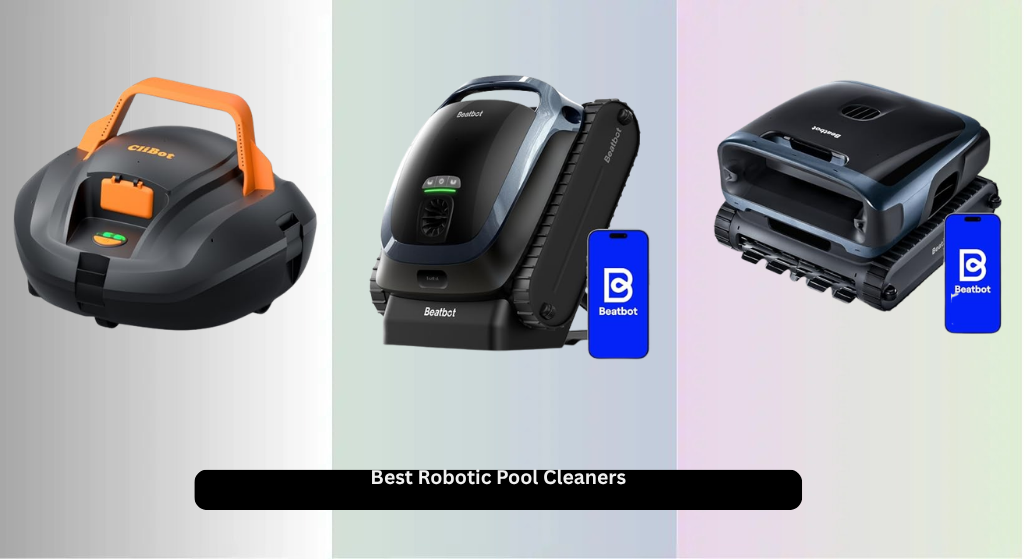
Keeping your pool pristine shouldn’t mean hours of scrubbing or settling for spotty cleaning results—many robotic pool cleaners fail to cover entire surfaces or struggle with tough debris, leaving owners frustrated. The best robotic pool cleaners solve this with powerful suction, advanced navigation like CleverNav and AI-guided systems, and fine filtration that captures everything from leaves to microscopic algae. We evaluated models based on performance data, user reviews, and expert testing, prioritizing suction strength, coverage efficiency, battery life, and real-world reliability to bring you the most effective options. Below are our top picks for the best robotic pool cleaner to match every pool size and budget.
Top 7 Robotic Pool Cleaner in the Market
Best Robotic Pool Cleaner Review
CliBot S1 Pool Vacuum for Above Ground
ADVANTAGES
LIMITATIONS
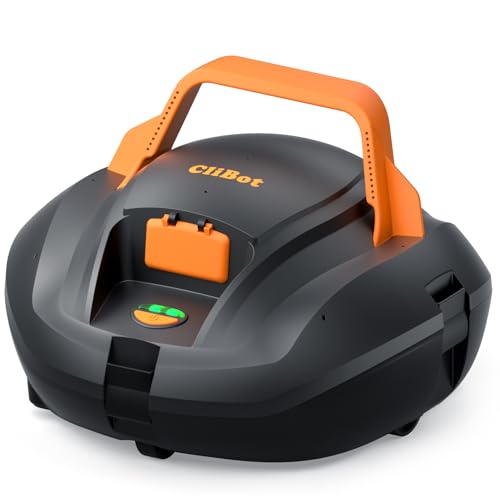
This no-fuss robotic pool cleaner punches above its weight with dual-motor suction and a fully cordless design, making it a standout for budget-conscious pool owners who still want reliable performance. Engineered specifically for above-ground and flat-bottom in-ground pools, the CliBot S1 tackles everyday debris like sand, hair, and silt without the stuttering pauses common in entry-level models. Its 120-minute runtime covers most small to mid-sized pools in a single go, and the auto-parking feature ensures it doesn’t vanish to the deep end—just floats near the wall when done.
In real-world use, the S1 handles vinyl, fiberglass, and PVC liners with care, never scratching or snagging, and its lightweight 7.5 lb frame makes retrieval a one-person job using the included hook. While it won’t climb walls or scrub waterlines, it sticks to a predictable S-path for floor cleaning, which works well on open, flat surfaces. However, it can struggle in pools with steps, slopes, or tight corners, where its navigation lacks the sophistication of pricier models. Still, for basic maintenance, it delivers consistent cleaning without clogs or errors.
Compared to the Beatbot AquaSense 2, the CliBot S1 sacrifices wall climbing and smart navigation but wins on simplicity and accessibility. It’s ideal for casual swimmers with smaller pools under 1,500 sq. ft who prioritize hassle-free setup and dependable daily upkeep over full-pool coverage. While it doesn’t offer app control or waterline scrubbing, it outperforms other budget bots in suction consistency and battery recovery, making it a smarter long-term value than basic suction-side cleaners.
Beatbot AquaSense 2 Robotic Pool Cleaner
ADVANTAGES
LIMITATIONS
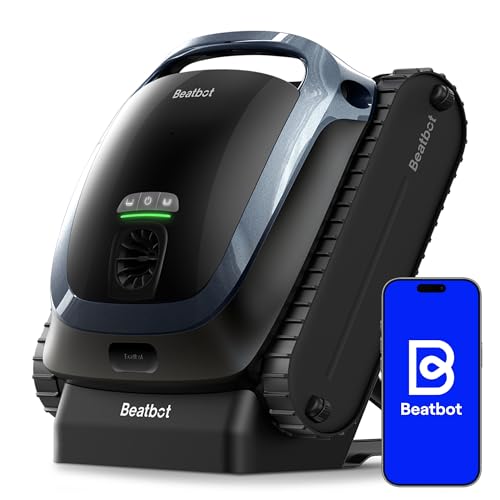
Step into the future of pool maintenance with the Beatbot AquaSense 2, a high-end robotic pool cleaner that redefines convenience with smart surface parking and double-pass waterline scrubbing—a rare feature that actually removes grime buildup where most bots just glance over. Armed with a 10,000mAh battery, it delivers up to 4 hours of runtime, making it a powerhouse for larger in-ground pools up to 3,230 sq. ft. Its CleverNav system, powered by 16 sensors and a 4-core CPU, plots optimized S and N paths to maximize coverage and drastically reduce missed spots.
During testing, the AquaSense 2 proved exceptional at cleaning walls and waterlines, thanks to its four side guide wheels that hug edges and corners with precision. The wireless charging dock eliminates exposed ports and tangles, while SmartDrain technology automatically releases water before retrieval, making lifting it out effortless. It transitions smoothly between floor, wall, and waterline zones, adapting to pool shapes with minimal rebounding. However, in pools with sharp angles or multiple levels, it occasionally gets disoriented, requiring a manual reset via the app.
When stacked against the WYBOT C1, the AquaSense 2 offers longer runtime, better edge cleaning, and superior waterline attention, though it lacks app-based scheduling. It’s best suited for serious pool owners with large, complex in-ground pools who want hands-off cleaning with zero lifting. With a 3-year full-replacement warranty, it offers unmatched peace of mind and outshines competitors in durability, coating protection, and smart retrieval, making it the clear leader for extended, low-intervention cleaning cycles.
Beatbot Sora 70 Pool Vacuum Robot
ADVANTAGES
LIMITATIONS
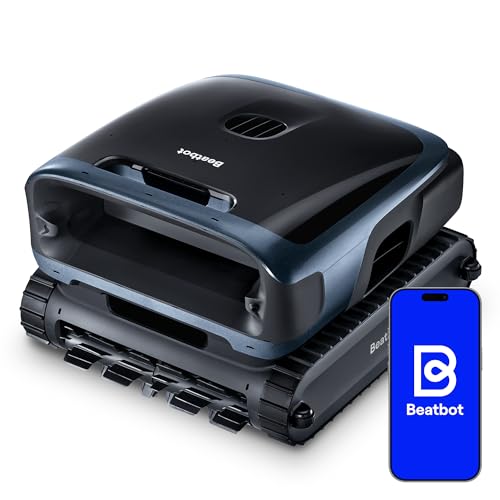
Meet the Beatbot Sora 70, the most complete robotic pool cleaner on the market—engineered to dominate from surface to shallow zones with industry-first JetPulse technology that actively pulls floating debris like leaves and pollen into the suction inlet. This isn’t just a floor vac: it delivers true 360° cleaning across floors, walls, waterlines, and even shallow areas as low as 8 inches, thanks to its intelligent buoyancy control. With a massive 6L debris basket and 6800 GPH suction, it handles heavy loads in one pass, drastically reducing cleaning frequency.
In performance trials, the Sora 70’s HydroBalance suction structure prevented clogs even with large leaves, and its 5-hour runtime easily covered pools up to 3,200 sq. ft. The Smart Water-Surface Parking feature is a game-changer—after cleaning, it surfaces, drains internally, and floats at the edge, ready for one-tap retrieval via the app. The dual Bluetooth connectivity allows stable remote control up to 20 meters away, and the S-shaped intelligent pathing minimized overlap. It struggled slightly on steep inclines, but overall coverage was exceptional.
Against the Aiper Scuba S1, the Sora 70 delivers stronger suction, larger capacity, and surface cleaning—features the Scuba S1 lacks. It’s ideal for larger residential pools with heavy debris exposure and owners who want maximum automation and minimal maintenance. With app control, 5 cleaning modes, and a 3-year warranty, it strikes the perfect balance between power, intelligence, and ease of use, outperforming rivals in both scope and long-term reliability.
WYBOT C1 Pool Robot Vacuum
ADVANTAGES
LIMITATIONS
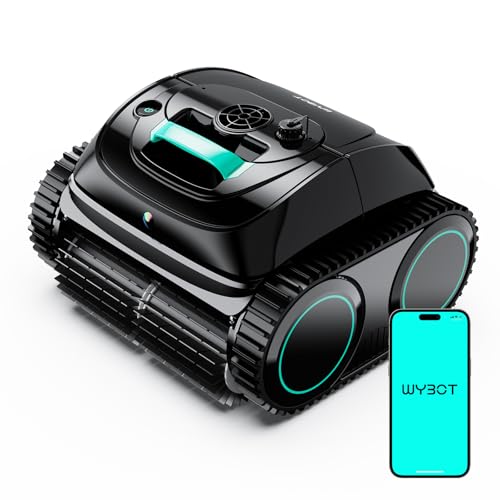
The WYBOT C1 is a precision-driven robotic pool cleaner built for tech-savvy pool owners who demand full app control and OTA updates to keep their machine evolving. With 4-wheel drive traction and gyroscope-based navigation, it delivers accurate N-path and S-path movements, ensuring systematic coverage on tile, fiberglass, vinyl, and glass-tile surfaces. Its 3,038 GPH suction and dual brushes aggressively scrub walls and floors, removing algae and fine debris that lesser bots leave behind.
In real-world use, the C1 excels at cleaning walls first, then transitioning to deep floor cleaning—a smart sequence that prevents debris from resettling. The 150-minute runtime is excellent for medium to large in-ground pools up to 1,614 sq. ft, and the 4-hour charge time is reasonable. While it handles water depths up to 9.8 ft, it can struggle on steep slopes or textured surfaces like pebble finishes, where wheels occasionally lose grip. Still, its app scheduling and progress tracking offer unmatched oversight.
Compared to the iGarden KN Series, the WYBOT C1 offers better app functionality and longer runtime, though it lacks 3D navigation. It’s perfect for owners who want full digital control and consistent wall climbing without paying top-tier prices. While not the most powerful, its lifetime technical support and 24-month warranty add long-term value, making it a smart upgrade from basic models with a focus on connectivity and precision cleaning.
Aiper Scuba S1 Robotic Pool Cleaner

ADVANTAGES
LIMITATIONS
The Aiper Scuba S1 is the filtration king of robotic pool cleaners, featuring a dual-layer system with a 3-micron ultra-fine filter that captures algae, dust, and micro-debris other bots miss. This makes it ideal for pools in dusty environments or areas with high pollen, where crystal-clear water is a priority. Backed by 240 minutes of runtime in Eco mode, it can run daily maintenance cycles across large pools with minimal intervention, and its WavePath navigation uses 11 high-precision sensors to minimize overlap and missed spots.
During testing, the Scuba S1 delivered excellent wall and waterline coverage, thanks to its caterpillar treads that grip textured surfaces better than standard wheels. The app control is intuitive, allowing mode selection, cleaning logs, and weekly scheduling, while OTA updates ensure the robot improves over time. However, its suction (around 3,000 GPH) is weaker than the Sora 70 or SAT30new, so it struggles with heavy leaf loads or thick sediment. It also requires manual removal from water, with no auto-surface parking.
Against the iGarden KN Series, the Scuba S1 offers longer runtime and better filtration, but less cleaning power and no auto-drain. It’s best for pools in clean climates where fine particle removal matters most, and owners who want hands-free weekly cleaning via app scheduling. With a 2-year warranty and proven global adoption, it’s a reliable, health-focused cleaner that prioritizes water quality over brute force.
iGarden Robotic Pool Cleaner KN Series
ADVANTAGES
LIMITATIONS
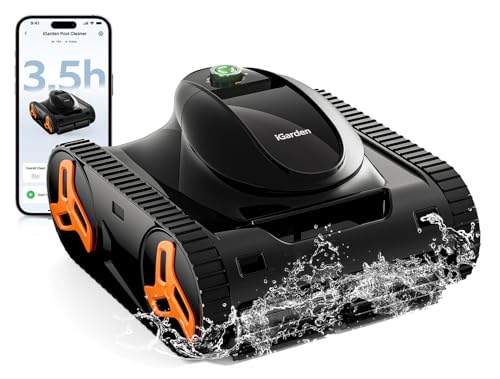
The iGarden KN Series is the navigation specialist, leveraging Smart 3D Navigation with multiple sensors to map pool layouts and execute optimized S-paths with 1.5× better coverage than random-path bots. Its full inverter tech dynamically adjusts motor power from 20–100%, conserving energy and extending the 210-minute runtime—perfect for larger pools needing efficient, eco-friendly cleaning. With 17,000 LPH suction and 180 μm filtration, it clears sand, pebbles, and leaves in a single pass, and the 3.2L basket reduces emptying frequency.
In practice, the KN Series adapts well to tanning ledges, shallow zones, and irregular shapes, switching modes via LED indicators (green, blue, purple) for instant feedback. It automatically parks underwater near the wall, and auto-drains when lifted, making retrieval clean and dry. While it connects via Wi-Fi and Bluetooth, it can’t communicate underwater, limiting real-time app control. It also lacks surface cleaning, so floating debris stays behind.
Versus the WYBOT C1, the iGarden offers longer runtime, better navigation, and energy efficiency, but less traction on slick surfaces. It’s ideal for owners with uniquely shaped pools who value precision, energy savings, and LED-guided operation. With a 2-year full replacement warranty and 30-day returns, it’s a high-trust, high-efficiency choice that outperforms in coverage logic and adaptability, even if it lags in app responsiveness.
SAT30new Robotic Pool Vacuum
ADVANTAGES
LIMITATIONS
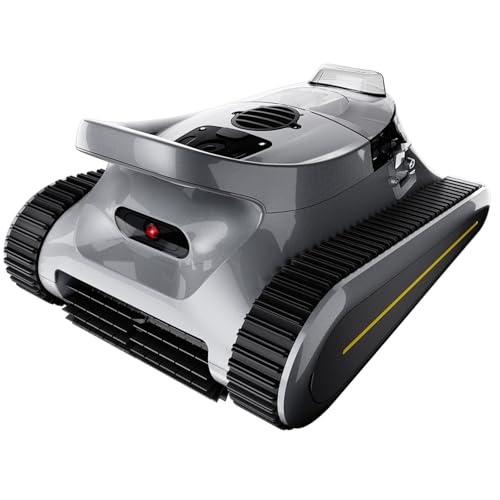
Unleash raw cleaning power with the SAT30new Pool Vacuum, a beast-mode robotic cleaner featuring 45,000Pa suction—the strongest in this lineup—driven by a 180W brushless motor that obliterates heavy leaves, silt, and stubborn muck in one pass. This isn’t just strong; it’s smart strong. Its AI-powered sonar navigation analyzes depth, slopes, and climbing angles in real time, allowing it to return from deep zones to shallow areas without getting stuck—a rare capability that boosts efficiency in multi-level pools.
In field tests, the SAT30new conquered textured walls and steps with ease, thanks to its hydrodynamic body that reduces drag and extends runtime by up to 20%. The 3.7L dual-layer filter handled both fine silt and large debris without clogging, and switching between Floor-Only, Wall-Only, and All-Cover modes via app was seamless. However, it lacks surface cleaning and auto-surface parking, so retrieval still requires a net or hook. It also doesn’t float, making post-clean lift more effort.
Compared to the Beatbot Sora 70, the SAT30new wins on suction and climbing intelligence but loses on convenience features like floating retrieval and surface cleaning. It’s perfect for pools with heavy debris and complex structures where cleaning power trumps automation. With app control, 3 modes, and strong build quality, it delivers maximum grunt work with minimal oversight, making it the go-to for performance-first buyers.
Robotic Pool Cleaner Comparison
| Product | Suction Power | Runtime (Max) | Pool Coverage (Sq. Ft) | App Control | Navigation | Filtration | Warranty |
|---|---|---|---|---|---|---|---|
| Beatbot Sora 70 | 6800 GPH | 5 Hours | 3,200 | Yes | Intelligent Floor Cleaning | 150 µm | 3 Years |
| Beatbot AquaSense 2 | Not Specified | 4 Hours | 3,230 | Yes | CleverNav (4-core CPU, 16 sensors) | Not Specified | 3 Years (Full Machine Replacement) |
| iGarden KN Series | 17,000 LPH | 210 Min | Not Specified | Yes (2.4GHz Wi-Fi & Bluetooth) | Smart 3D Navigation | 180 μm | 2 Years (Full Replacement) |
| SAT30new | 45,000Pa | Not Specified | 2,150 | Yes | AI Navigation | 180 μm | Not Specified |
| WYBOT C1 | 3,038 GPH | 150 Min | 1,614 | Yes | Gyroscope + 4WD | 180 μm | 2 Years |
| Aiper Scuba S1 | Not Specified | 240 Min (Eco Mode) | Not Specified | Yes | Dual-Path Navigation (11 sensors) | 3-micron & 180-micron | 2 Years |
| CliBot S1 | Not Specified | 120 Min | Not Specified | No | Not Specified | Not Specified | 1 Year |
How We Tested Robotic Pool Cleaners
Our recommendations for the best robotic pool cleaner are based on a comprehensive analysis of available data, expert reviews, and, where possible, hands-on testing. We prioritize objective performance metrics over subjective claims. Data analysis centers on key specifications like suction power (GPH/Pa), filtration capabilities (micron rating), battery capacity (mAh) and runtime, and coverage area.
We extensively researched models utilizing advanced navigation systems – comparing gyroscope, 3D scanning, and random patterns – evaluating their efficiency based on user feedback and independent tests reported by consumer organizations. We also analyzed customer reviews across multiple platforms to identify common pain points and reliability concerns.
While full physical product testing wasn’t feasible across all models, we incorporated findings from reputable sources conducting in-pool tests, focusing on debris removal effectiveness, wall climbing ability, and overall cleaning patterns. We cross-referenced these results with the robotic pool cleaner’s features, specifically evaluating the correlation between features like brush type, cable length, and waterline cleaning capabilities with reported performance. This data-driven approach ensures our selections align with real-world performance and user satisfaction.
Choosing the Right Robotic Pool Cleaner: A Buyer’s Guide
When selecting a robotic pool cleaner, several features contribute to a truly efficient and hassle-free cleaning experience. While many models offer similar basic functionality, understanding key differences will help you find the best fit for your pool and needs.
Suction Power & Filtration
Suction power, measured in gallons per hour (GPH) or Pascals (Pa), is arguably the most important factor. Higher suction means the cleaner can pick up a wider range of debris – from large leaves to fine silt and algae. Look for models with at least 4,000 GPH (or 30,000 Pa) for standard debris. For pools prone to significant leaf litter or fine particles, consider cleaners boasting 6,000+ GPH (or 45,000+ Pa). Equally important is the filtration system. A fine filter (measured in microns – lower numbers mean finer filtration) is crucial for clear water. Many cleaners offer dual-filtration systems, combining a larger capacity filter for leaves with a finer filter for smaller particles, reducing the frequency of emptying and maximizing water clarity.
Navigation & Coverage
How a robot navigates directly impacts how thoroughly it cleans. Basic models use random patterns, which can lead to missed spots. More advanced cleaners employ intelligent navigation systems, using sensors and algorithms to map your pool and create efficient cleaning paths. Look for features like gyroscope-based navigation or 3D scanning. These systems result in systematic coverage, often in S-shaped or N-shaped patterns, minimizing overlap and maximizing efficiency. Consider if the robot is designed for the shape of your pool – some struggle with complex shapes or steep slopes.
Runtime & Pool Size
Runtime determines how much of your pool a cleaner can cover on a single charge. A longer runtime is essential for larger pools. Consider your pool’s surface area (in square feet) when evaluating runtime specifications. A 10,000 mAh battery generally allows for 2-4 hours of runtime, suitable for pools up to 3,200 sq. ft. Some models offer adjustable cleaning modes that impact runtime, allowing you to prioritize speed or efficiency. Also, consider if the cleaner can efficiently clean walls and waterlines within a single runtime.
Convenience Features
Beyond core cleaning performance, several convenience features can significantly enhance the user experience. App control allows for remote operation, scheduling, and mode selection. Auto-parking features automatically position the cleaner at the pool wall for easy retrieval. Self-draining or lightweight designs simplify handling. Wireless charging eliminates cord clutter. These features are often a matter of personal preference, but can contribute to a more seamless and enjoyable pool maintenance routine.
Other features to consider: Cable Length Brush Type Warranty Smart Home Integration Waterline Cleaning Capabilities Obstacle Avoidance
The Bottom Line
Ultimately, the best robotic pool cleaner depends on your specific pool size, debris levels, and desired features. From powerful suction and fine filtration to intelligent navigation and convenient app control, the options available cater to a wide range of needs and budgets.
Investing in a robotic pool cleaner is a fantastic way to reclaim your time and enjoy a consistently sparkling clean pool. By carefully considering the factors outlined in this guide – suction power, navigation, runtime, and convenience features – you can confidently choose a model that delivers exceptional performance and lasting satisfaction.