








Vacuum Cleaner Power Cord Damaged: Warning Signs, Safe Steps, and Repair or Replace Guide
A damaged power cord is one of the most serious problems a vacuum cleaner can have. Unlike a clogged filter or a tangled brush roll, a faulty cord is not just an inconvenience. Exposed wires, cracked insulation, or a burnt plug can cause electric shock, short circuits, or even a fire. Because a vacuum cord is pulled, twisted, run over, and wound up again and again, damage is common over time.
This guide explains how to spot a damaged power cord, what to do right away, whether to repair or replace it, and how to stop it happening again. The aim is to keep you and your home safe.
Warning Signs of a Damaged Vacuum Power Cord
- Cuts, cracks, or nicks in the outer insulation
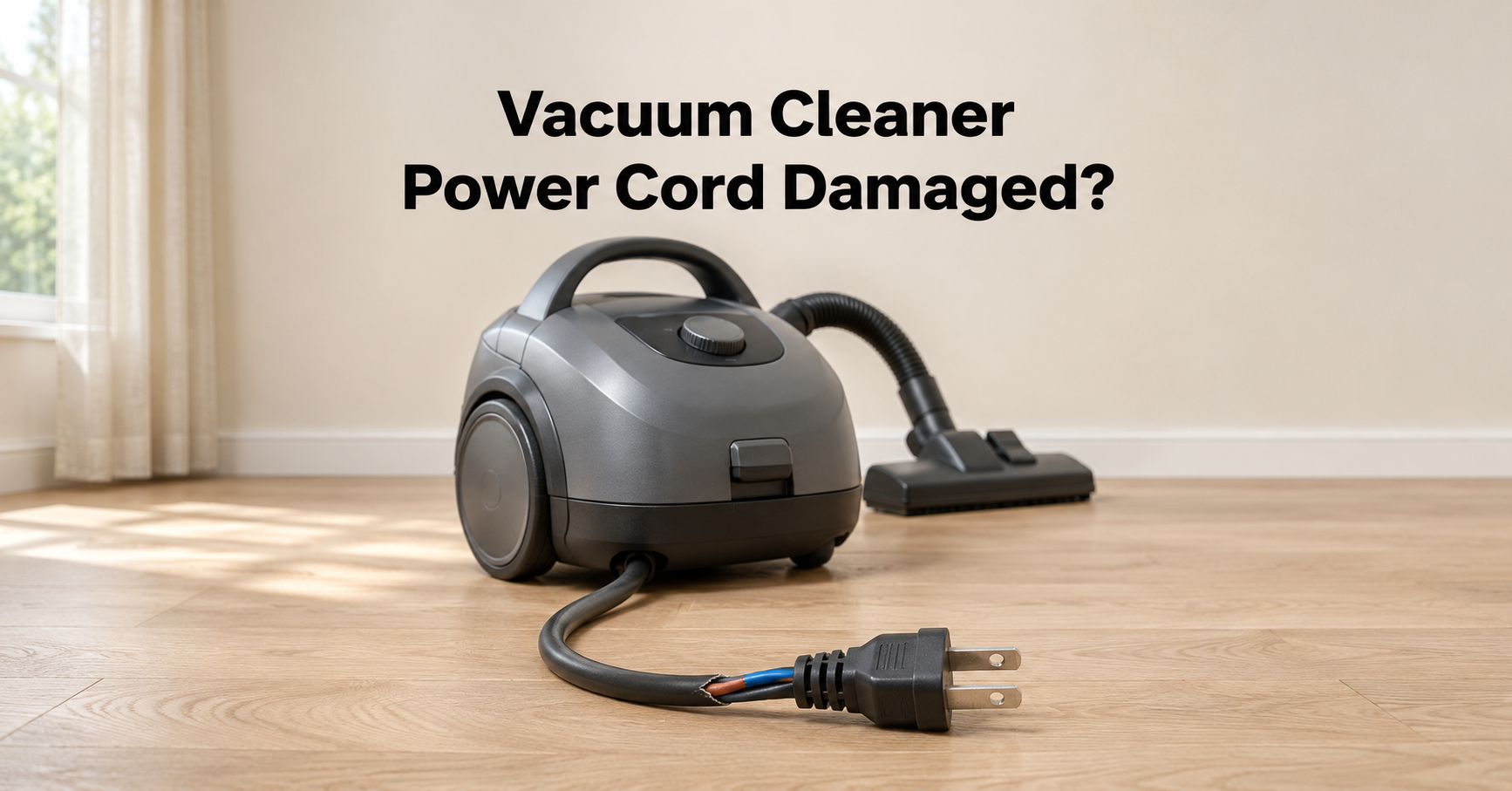
- Exposed or frayed wires, where copper or colored wire is visible
- Kinks, bulges, or flattened sections that suggest crushed internal wires
- A hot, discolored, or burnt plug, or a burning smell during use
- Sparks, flickering, or power cutting in and out when you move the cord
- A loose connection where the cord meets the plug or the vacuum body
- A cord that feels unusually hot while the vacuum runs
- A tripped circuit breaker every time you switch the vacuum on
What Causes a Vacuum Cord to Get Damaged?
- Running the vacuum over the cord, which crushes or cuts it
- Pulling the plug out by the cord instead of gripping the plug
- Sharp bends and twists from poor winding or storage
- Repeated stress at the entry point, where the cord leaves the vacuum or plug
- Catching in doors, furniture legs, or sharp edges
- Retractable reel wear, where the cord is yanked back or pulled past its limit
- Pet chewing, especially by puppies, cats, and rabbits
- Heat and age, which make insulation brittle over the years
- Overloading, such as long-term use with a loose or weak outlet
Why a Damaged Cord Is Dangerous
- Electric shock: exposed wires can be live, and touching them can cause serious injury.
- Fire risk: damaged conductors can overheat, arc, or ignite nearby materials such as carpet, dust, or fabric.
- Short circuits: damaged insulation can cause a short that trips breakers or damages the motor.
- Damage to the vacuum: intermittent power can stress the motor and electronics.
What to Do Immediately if Your Vacuum Cord Is Damaged
Step 1: Stop using the vacuum
Switch it off right away. Do not keep vacuuming to finish the room, even if the damage looks minor.
Step 2: Unplug it safely
Grip the plug firmly and pull it from the wall socket. If the cord is hot, sparking, or the plug is melted, do not touch exposed parts. Turn off power at the circuit breaker first if you have any concern about safety.
Step 3: Inspect the full length of the cord
With the vacuum unplugged, run your hands slowly along the cord and look closely at the insulation, the plug, and both ends. Check where the cord enters the vacuum body, since that is a common failure point.
Step 4: Decide what to do
Minor surface scuffs that do not expose any wire may be acceptable, but any cut, exposed wire, burn mark, kink, or loose plug means the cord needs to be replaced. If in doubt, do not use it.
Step 5: Replace the cord or have it repaired
Use the correct replacement cord for your model, fitted by a qualified person if it is not designed for user replacement.
Can You Repair a Damaged Vacuum Power Cord?
This is where safety matters most. Taping over a damaged cord is not a safe repair. Electrical tape can slip, melt, or hide damage that continues inside. The safest approach is always to replace the damaged cord or the full cord assembly.
Detachable or plug-in cords
Some vacuums, especially certain stick and handheld models, use removable power cords or adapters. In that case, simply replace the cord with an approved one made for your model.
Fixed cords on corded vacuums
Most corded vacuums have a cord permanently connected inside the machine, and often wound on a reel. Replacing this involves opening the housing and connecting wires correctly. Many manufacturers require this to be done by an authorized service center, and doing it yourself without the right skills can create a hidden hazard.
Retractable cord reels
If the cord is wound on a reel under spring tension, the reel itself may need replacing. This is another job best left to a qualified technician.
Replace the Cord or the Vacuum?
Compare the cost of a genuine replacement cord and the repair labor with the price of a new vacuum. For a newer, good-quality machine, a cord replacement is often worthwhile. For an older vacuum with other problems, a new vacuum may be the better investment.
How to Choose a Safe Replacement Cord
- Match your model: use a cord designed for your exact vacuum.
- Check the ratings: voltage, amperage, and plug type must suit your machine and your country’s standards.
- Prefer original or approved parts: they are tested to fit and perform safely.
- Look for safety marks: certified cords carry recognized safety approvals.
- Avoid unbranded or very cheap cords: thin wires can overheat.
- Check the cord length and gauge: a cord that is too thin or too long can heat up.
Should You Use an Extension Cord With a Vacuum?
An extension cord is not a fix for a damaged cord. If you need extra reach, choose a heavy-duty cord rated for the vacuum’s power, and keep it undamaged and fully uncoiled when in use. Never connect a damaged vacuum cord to an extension cord to keep using it.
How to Prevent Vacuum Cord Damage
- Always pull the plug out by gripping the plug, never the cord.
- Keep the cord clear of the vacuum wheels and brush head.
- Do not wrap the cord tightly around the machine; use loose loops.
- Guide the cord by hand when it retracts.
- Do not pull the cord beyond its marked limit.
- Keep it away from sharp edges, hot surfaces, and closing doors.
- Inspect the cord and plug every few months.
- Keep pets away from the cord, and store it out of reach.
- Store the vacuum in a dry place, away from heat.
When to Call a Professional
- You see exposed wires, melted insulation, or burn marks
- The vacuum smells of burning or trips the breaker
- The cord is fixed inside the vacuum or wound on a reel
- The wall socket looks scorched or damaged
- You are not confident working with electrical parts
Frequently Asked Questions
Is it safe to use a vacuum with a damaged cord?
No. Even small cuts or exposed wire can cause shock or fire. Stop using it until the cord is replaced.
Can I fix a vacuum cord with electrical tape?
Tape is not a safe, lasting fix for a damaged power cord. It can slip, overheat, or hide damage. Replace the cord instead.
Can I replace a vacuum power cord myself?
Only if your model is designed for user replacement, such as a detachable cord. Otherwise, use an authorized service center, because fixed cords connect to internal wiring.
How much does it cost to replace a vacuum cord?
The price depends on the model and on whether you need parts only or labor too. For older, low-cost vacuums, a new machine may be more economical.
Why is my vacuum cord getting hot?
It may be damaged internally, overloaded, or have a loose connection. Unplug it and have it checked before using it again.
Will my warranty cover a damaged power cord?
It depends on the cause. Manufacturing faults are often covered, while damage from misuse, cuts, or crushing usually is not. Check your warranty terms.
How often should I inspect my vacuum cord?
A quick look before each use is a good habit, with a closer inspection every few months.
Final Thoughts
A damaged vacuum power cord should never be ignored. The moment you see cuts, exposed wires, a hot plug, or sparks, stop using the vacuum and replace the cord with a correct, safe part, fitted by a qualified person where required. Handle the cord with care, inspect it regularly, and your vacuum will stay both effective and safe for years to come.